

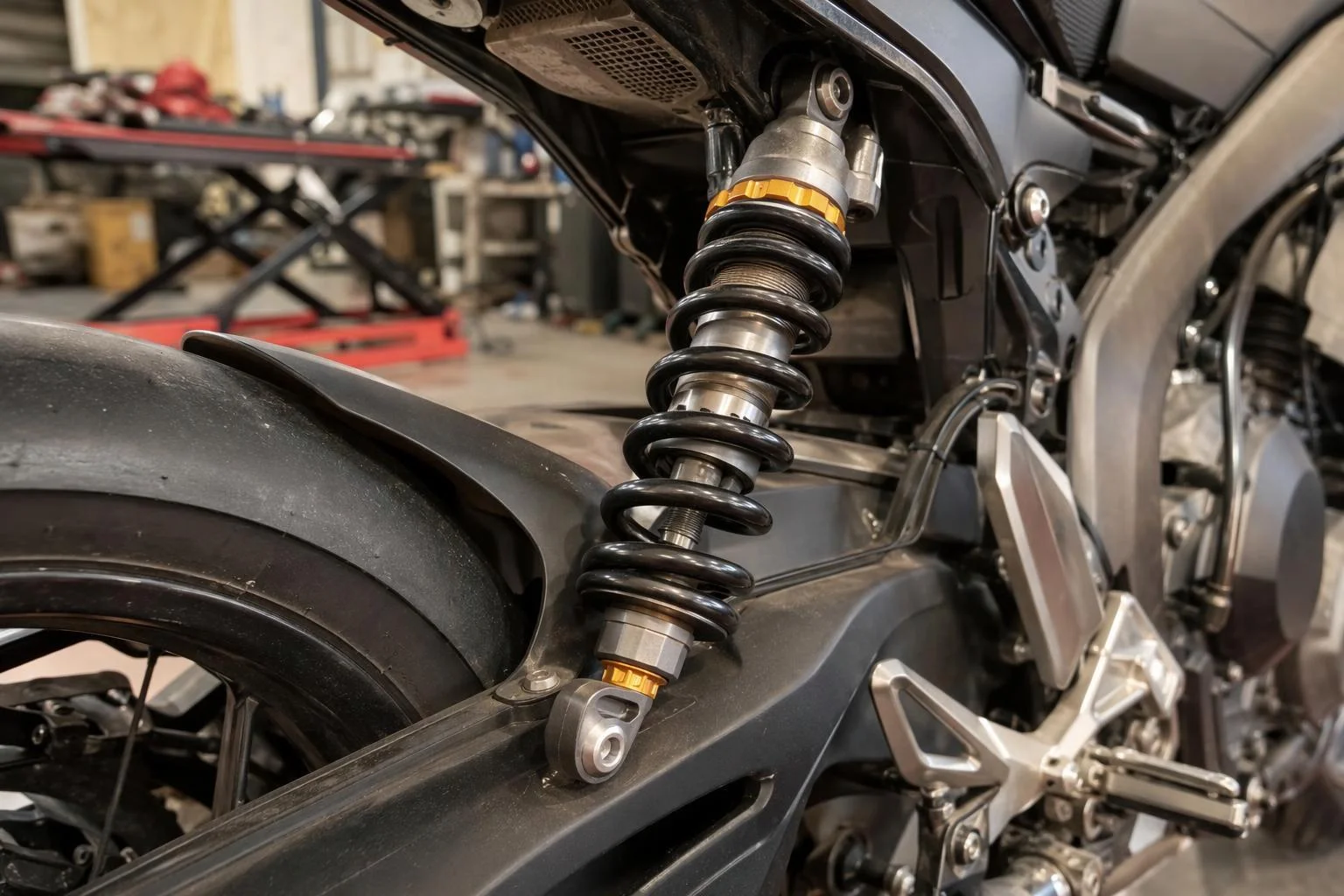
A rear shock is a product component that directly affects how a motorcycle feels and performs. Differences in fitment, spring rate and damping characteristics become apparent the moment the bike is ridden, so specification, configuration and performance targets need to be settled during development rather than after the first batch has shipped. Sample validation and mass-production consistency also get confused with each other. A damper that hits the target on the bench still has to be buildable the same way, unit after unit, and those two facts are proven by different evidence.
This guide is written for brands building their own rear suspension line, and it stays close to the decisions you actually have to make: which development model fits your situation, what a well-run ODM project looks like stage by stage, how MOQ and prototype timing are set, which configuration choices have to be locked early, and which records are worth asking for before you commit to volume. By the end you should know what to prepare, what to ask, and which answers can be checked against documents instead of taken on trust.
OEM vs. ODM: Which Development Model Is Right for Your Brand?
The two models differ less in who owns the factory than in who carries the design and development work. In OEM, the brand supplies the specification or drawing and the manufacturer builds to it. In ODM, the manufacturer takes a larger role in product design and development, either by adapting an existing platform or developing a product around the brand’s requirements. The brand defines the application, performance expectations and commercial positioning, then reviews and approves the proposed design. Most rear shock programs sit somewhere between the two, so the practical question is where each project starts and how much of the development the brand is equipped to carry.
OEM is the better choice when the brand already owns the design intent: a defined drawing, mounting geometry or damping target that should not be re-engineered around a supplier’s existing part. The brand carries the work of defining and validating that specification, and in return retains greater control over the design requirements and approval process. That control is what the brand pays for in engineering time, drawings and approval effort.
Neither model settles who owns the intellectual property, whether the design stays exclusive, or who holds the tooling. Those belong in the development or supply agreement, and they are worth settling in writing before the first drawing is released: who owns the original design and drawings, who owns modifications made during development, who funds and holds the molds, whether the supplier may offer the same or a similar design to other customers, and which technical documents the brand may take with it or share with another supplier. In practice we have seen more disputes start from an unstated assumption here than from any technical disagreement, and a brand that reads OEM as built-in exclusivity may be relying on a clause that does not exist.
ODM makes more sense when the brand would rather the supplier carry the engineering work while its own team concentrates on the product decision — what the shock should do, for whom, and at what price. Differentiation then comes from positioning, finish, packaging and channel choices made on top of that development. If a supplier’s existing platform already covers the intended fitment and performance band, the project can start from that platform and concentrate on spring rate, adjuster set, finish and branding within its limits. The trade-off is that the brand accepts the platform architecture, has to confirm which changes the supplier can make without new tooling, and needs to agree up front whether it keeps control of the performance targets and the approval steps it depends on.
OEM vs. ODM comparison
Decision factor | OEM | ODM |
|---|---|---|
Design responsibility | Brand supplies the specification or drawing | Supplier brings an existing platform or develops one to the brief |
Development burden | Brand defines and validates the design | Supplier develops the platform; brand sets positioning and approvals |
Differentiation | The brand’s own design | Positioning, finish, branding and selected configuration |
Tooling | Depends on what changes; a change to the design is more likely to require it | Existing tooling may cover the project, depending on the change |
Best fit | Brand has its own design starting point and can carry the engineering work | Brand needs a proven base and wants the supplier to carry the development |
Main risk to manage | The brand’s own definition and validation work | Change scope must be confirmed against the platform |
The Rear Suspension ODM Development Process: From Requirements to Mass Production
An ODM rear shock project moves through stages that each answer a different question, and skipping one usually surfaces later as a production problem rather than a design one. The split that matters most is between product validation — does the damper meet the performance intent — and process validation — can it be built repeatedly with controlled variation. A sample can pass the first and still fail the second, which is why the later stages exist. The five stages below follow our own OEM/ODM lifecycle management for scalable production, which sets out the same gate sequence in more detail. Treat the labels as checkpoints rather than an industry standard: plenty of projects skip a name, run two stages together, or carry a customer’s own gate in the middle.
Requirements and application assessment. This stage turns the brief into a specification someone can measure. The brand supplies the motorcycle model, year and generation, mounting dimensions such as eye-to-eye length and upper and lower mounting type and width, clearance around the reservoir or spring, load and riding conditions, adjustment target, branding and packaging, and target annual quantity. The supplier then classifies the project as an existing platform, a component-level change or a dedicated development, since that classification drives tooling, sample plan, MOQ and schedule. Most delay we see at this stage comes from a brief that describes a feeling (“firmer than stock”) rather than a number, because nothing like that can be signed off at final inspection.
Prototype development. The brand should approve drawings before samples are cut, then judge the sample against the agreed specification rather than a general impression. Sample stages vary by supplier and project — prototype, engineering sample, EVT/DVT, sometimes a pilot run — and they are not standard across makers or customers, so the labels matter less than the question each stage answers. A more useful control is to agree what each stage must approve before the next one starts: does the mounting and dimensional fit pass, does the damping match the target curve, do the adjusters work through their range, is durability testing needed, and is the design ready to move into production validation? Put that list in the project file. One failure worth watching for: a sample approved as “fits” quietly becoming the reference for a production run, even though it was built on prototype tooling and hand-assembled.
Dynamometer testing (dyno) and performance validation. A shock dynamometer measures the damper’s force response at defined shaft speeds during compression and rebound, and the force-velocity curves it produces are what engineers compare against the agreed performance targets. For an ODM project, what matters at this gate is that test conditions, reference curves and acceptance criteria are agreed in advance, so the sample is judged against them rather than against an impression. Passing here says the product meets the performance intent; it says nothing yet about whether the same unit can be built the same way next month.
Production Part Approval (PPAP), where required. PPAP is commonly associated with automotive supply-chain requirements, and whether it applies to a motorcycle rear shock program depends on the customer’s quality requirements and the approval process agreed for that project. Where a customer does require it, it is the evidence package a supplier submits to demonstrate that its established manufacturing processes have the repeatability and reliability to produce product meeting all requirements during an actual production run at the specified production rate, as set out in the Welbilt PPAP manual. The submission is warranted by the Part Submission Warrant (PSW), and the elements can include dimensional results, process flow diagrams, PFMEA, control plan, MSA studies and initial process studies. Confirm the submission level and the specific elements the supplier can actually provide, and treat approval as a gate rather than a formality: a PPAP package does not retire every risk.
Mass production preparation. Production readiness is not the same milestone as part approval, and the order in which they happen depends on the project. Where PPAP applies, the production part approval follows the customer’s requirements; production preparation still has to lock the inputs the line depends on — material sourcing, tooling availability, packaging, inspection points, batch traceability and the production schedule. A program is not “sample approved, PPAP closed, therefore in production”: confirm what the supplier’s lead time measures from and what it includes, and agree the inspection plan that will carry the approved configuration into volume.
MOQ and Prototype Lead Time: What Brands Should Know
MOQ and lead time are the two numbers brands ask about first, and the two most often quoted without their conditions. Both come out of the project classification rather than a catalog: a supplier typically sorts an inquiry into an existing platform, a component-level change, or a dedicated development, and that classification drives the minimum quantity, the tooling requirement, the sample plan and the schedule. Working through the sequence from MOQ, tooling and samples to lead time in that order saves most of the back-and-forth later.
Standard MOQ vs. custom MOQ. The minimum typically follows the production setup rather than the OEM/ODM label. That is why it rarely arrives as one number: MOQ may be calculated per model, per configuration, or according to the setup a particular project needs. Component-level changes and dedicated development can also add tooling requirements, sample stages and development time, depending on the scope of the project. A brand launching several fitments should therefore confirm where the minimum applies, whether quantities can be combined across models, which components or processes are shared between them, and whether reorders carry a different minimum from the first order. Get those answers in writing for the mix you actually plan to sell, along with the replenishment plan the supplier proposes for year one — otherwise a small-looking figure can turn into an order that cannot be built as quoted.
Prototype lead time for standard and custom projects. Lead time is not one number, and it does not start at the same point for every supplier: some treat order confirmation and material sourcing as sitting inside the production clock rather than before it, and lead time is not the same term as delivery date. How long a supplier quotes also depends on the project type: a drawing set for a dedicated development takes longer than adapting an existing platform, and sample timing moves with tooling, material procurement and the sample stages the customer asks for. A single headline number is worth very little until you know what it covers, so rather than plan around a figure, put four questions to the supplier before you rely on it:
Are the days calendar or working days?
Does the clock start at specification sign-off, order confirmation or payment?
Does the sample allowance include material procurement and new tooling, or does tooling run ahead of it?
Which project type does the range apply to — a new platform, or a reuse of existing tooling?
Any of those answers can move the real date by weeks. Until the sample is approved and the production inputs are locked, a quoted date is an estimate, not a schedule.
What to confirm before requesting a quote. Lock the platform first — model, model years and target market — then eye-to-eye length, the upper and lower mounting type and width, clearance around the reservoir or spring, your adjustability tier, and the load profile the shock will carry. The rear shock quoting parameters most RFQs leave out until the second round are exactly these. Add the target annual volume and model mix, since those drive the minimum and the schedule. Then apply the same questions to every change: what exactly changes, whether existing tooling covers it, who pays for new tooling or development work, who owns the tooling and drawings afterwards, and how it moves the timeline. Funding and ownership are separate items — paying for a mold does not automatically settle who keeps it.
Rear Shock Configuration Options for OEM/ODM Projects
Configuration is where a rear shock program becomes a product rather than a part number. The adjuster set, the reservoir architecture and the spring-to-damping match each change what the rider feels, what the unit costs and how much of the catalog it can cover. These decisions are cheap to change on paper and expensive to change after tooling, so they belong in the requirements conversation, not the purchase order.
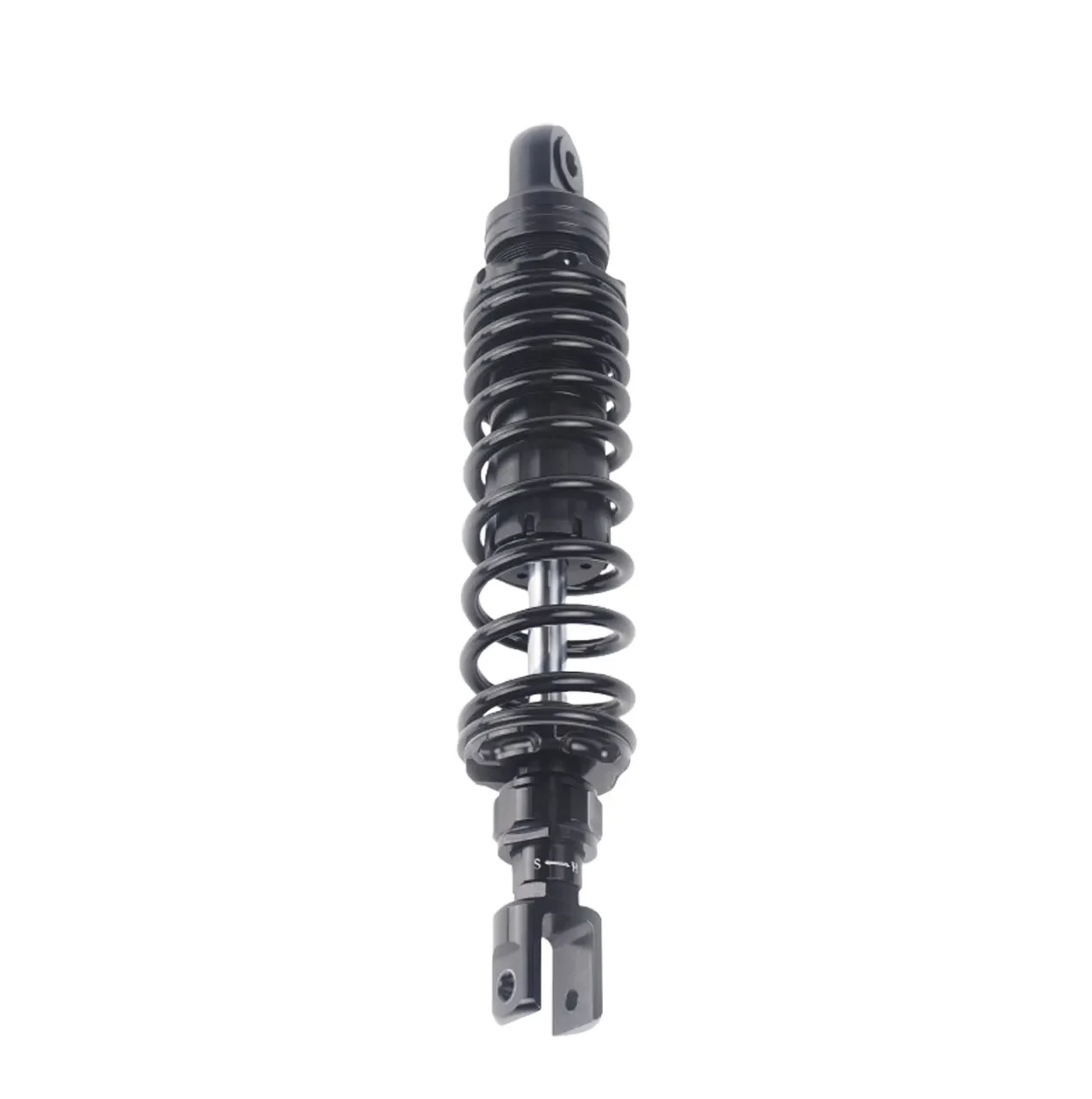
Preload, Rebound and Compression Adjustment. Adjustability is a ladder rather than a single feature. The usual steps are preload only, preload plus rebound, or preload plus rebound plus compression, and Kingham builds each of those combinations, so which step applies to a given platform is a question for the quotation rather than an assumption. Each step up adds a setting the rider can change and a claim the brand has to support. Preload changes the spring’s initial compression, which is how ride height and static sag are set for solo, two-up and luggage loads. What it does not do is change the spring rate: a spring that is too soft for the load stays too soft however much you wind the collar. Picking a rate that matches the intended load still comes first, and a hydraulic preload adjuster is a convenience for changing the setting quickly, not a substitute for the right spring. Rebound governs how fast the unit extends after being compressed, and compression governs resistance as the shaft moves inward. A preload-only unit sells on fitment and simplicity; adding rebound and then compression widens the tuning window but obliges the brand to explain, in rider terms, what each adjuster changes.
Reservoir and Non-Reservoir Designs. The practical split is between shocks that carry the oil in the main body and designs that add a separate reservoir, which mounts either piggyback on the body or remotely on a hose. Reservoir designs can provide additional oil capacity and help manage heat under demanding operating conditions, although the actual benefit depends on the shock’s internal design, the intended duty cycle and the overall damping setup — a reservoir on a poorly specified damper does not fix a fade problem. Internal construction varies too: an emulsion shock and a shock with a separating piston are both non-reservoir designs, but they behave differently, so it helps to ask what sits inside the body rather than treating the categories as interchangeable. Confirm platform clearance around the reservoir or spring as part of the brief, since that dimension can rule out a design before price does.
Matching Spring and Damping Requirements. Spring rate follows the motorcycle, the load profile and the intended use, and damping is a defined window rather than a single number, so the two are specified as a pair. Damping force varies with shaft speed and with the shock’s internal valving characteristics, which is why the spring and damping setup should be evaluated together against the intended load and riding conditions. One pattern we see fairly often: a brand picks a heavier spring for two-up and luggage work and never re-checks the valving, which is one route to instability under a passenger and luggage.
Three questions worth settling before quoting. Which adjustment steps will riders actually use, and can each one be checked at the end of the line? Reservoir or not: does the platform carry the packaging, and does the duty cycle create a fade risk? And what load profile, spring rate and damping target define acceptance in measurable terms? That third one is usually the one that changes the quotation, because until the load, the damping requirement, the spring rate, the adjustment range and the conditions the shock will see are written down, nobody is quoting the same product.
Quality Control and Consistency in Mass Production
Consistency is the part of a suspension program that riders notice only when it fails: one unit feels planted, the next feels harsh, and the brand absorbs the returns. Production quality control exists to make unit 5,000 behave like the approved sample. For a brand, the question is less whether the factory has a quality system than which records you will be able to look at when a batch is questioned.
Three kinds of evidence. Almost everything worth asking for in a rear shock program falls into three groups.
Evidence type | What it proves | What to ask for |
|---|---|---|
Dimensional inspection records | Mounting dimensions and critical components match the approved drawing | Which characteristics are inspected, at which process steps, with what gauge |
Dyno and performance records | Damping behaviour matches the approved target | Test conditions, reference curves, acceptance criteria |
Fatigue and corrosion results | Durability and finish hold up where the project claims they do | Test standard, load or cycle conditions, duration, result |
The rows are evidence categories to request, not a list of tests every supplier runs as standard: dyno and fatigue testing are common in suspension production, while corrosion testing such as salt spray is usually tied to a finish specification or a customer requirement, so ask which of these the supplier performs in-house, which are outsourced, and under what standard. Ask for records from a production run rather than a hand-built sample, and for the calibration history of the gauges behind them — including whether external calibration goes to a laboratory accredited to ISO/IEC 17025. Note that ISO/IEC 17025 certifies laboratory competence; it is not a calibration standard itself. For critical dimensions, brands may also request process capability data such as Cp and Cpk, but only where there is enough production data to interpret it. Not every project warrants them, and an index computed on thin data tells you little.
Traceability. Traceability is what lets a complaint be settled with evidence instead of argument: a finished unit that links to its batch, the components that went into it and that batch’s inspection records. Ask to see an example record, and ask which identifier on the product connects back to it.
Certificates versus batch data. A management-system certificate and a batch record answer different questions. Where a customer’s supply-chain requirements call for it, an IATF 16949-certified system can provide additional assurance of process discipline, as DQS explains in its overview of the standard, but certification is audited against the system, not against your part, and it does not replace product-specific inspection records or performance validation. Treat certificates as evidence of the management system, and batch records as evidence of how your specific product was manufactured and inspected.
One practical test of all of this: ask how a batch would be re-checked if a customer complained eighteen months after delivery. A supplier that can describe the route — from the returned unit back to its batch and that batch’s records — is describing a system it actually runs.
That test is worth running before SOP rather than after, because the failure modes behind suspension OEM projects that fail after production starts tend to surface on the same route a complaint would travel.
How to Evaluate a Manufacturer’s Ability to Deliver Your Project
The question this section answers is narrow on purpose: can this supplier take your rear shock from a written requirement to repeatable production? It is not a factory audit, and it is not a scorecard of equipment, certifications or after-sales terms — those belong to a distributor evaluating a production partner for a volume order. What follows is a check of the development capability your own project will depend on. Use it as a checklist of what to ask for; which of these a given supplier can already document is a separate question, and one you should settle with their own records.
The earlier sections explain why each item matters; this one is about how to verify it. Work through each row below, ask the question, then ask to see the artifact.
Check | What to ask | What you should see |
|---|---|---|
Requirement translation | Who turns our brief into a specification, and what do you need from us to do it? | A written specification derived from your brief, with measurable acceptance criteria |
Design change control | Who approves a change, and how is the approved version identified? | A revision record showing who approved what and when |
Sample gating | What must each sample stage prove, and who signs off before the next stage begins? | Sample reports with test conditions and a named approval |
Process readiness | How will the approved sample be transferred to the line? | Inspection plan and process documentation tied to your part number |
Project planning | What does the timeline measure from, what does it include, and where are your dependencies? | A dated project plan with dependencies and the start point defined |
The verbal answer and the document you are shown rarely match, and the gap between them is usually the more useful information. Ask for the artifact specific to your project rather than a generic sample pack: a revision record from another program proves the format exists, not that your part is under control. File the answers next to the documents, so a claim made in a meeting can be compared with a record that arrives three months later. A supplier solid on four rows and vague on the fifth has shown you where your project’s risk sits.
For the wider criteria behind these checks — including capacity, quality systems and commercial risk — see how to evaluate a motorcycle shock absorber manufacturer.