

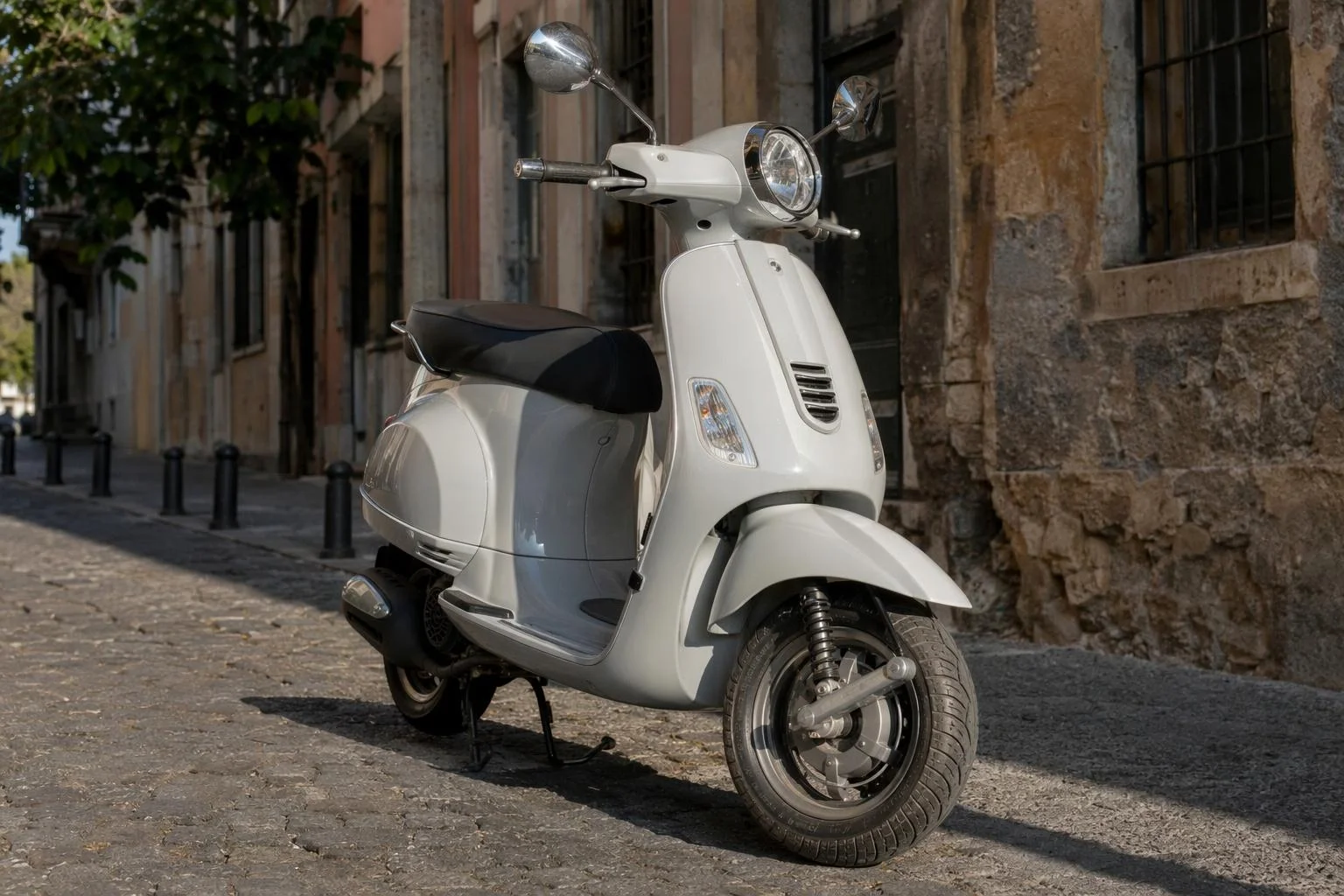
Most Vespa suspension upgrade conversations start in the wrong place: with a price list. A dealer or shop picks the most expensive shock in the catalogue, fits it, and the customer rides away expecting a transformed scooter. Sometimes the ride does improve. Often the complaint that brought the bike into the workshop — a vague front end, a nervous feeling over broken tarmac, a harsh crash over expansion joints — is still there.
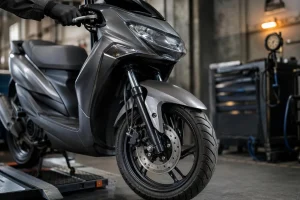
The reason is structural, and it has nothing to do with the shock. A Vespa Sprint or Primavera does not carry its front wheel the way a conventional motorcycle does. The front is held on one side only, by a single-sided link arm with a coil spring and a monoshock absorber, as the Piaggio technical sheets describe it for the Primavera 125. That single-sided arrangement is what makes the scooter feel the way it does, and it is also what makes the front the most sensitive part of any upgrade.
So the decision does not begin with “which shock is best”. It begins with why the front behaves differently, then the order of work, then the choice by model and by use. That’s the sequence this guide follows for dealers, modification shops and distributors building a Vespa suspension programme. It stays on principle and selection logic; where a specific fitment question comes up, confirm the spec pack by model with the supplier rather than assuming a part number carries across the range.
Why the Single-Sided Front Is Different
On a conventional telescopic fork, two stanchions share the front load. Each side carries roughly half the bending and braking forces, and the pair acts as a matched set: when one leg compresses, the other is doing similar work at the same moment. A Vespa’s front is not that. One link arm, one spring, one damper — the whole front end is a single load path, mounted to one side of the wheel.
Engineers call this layout a single-side trailing link: the trailing arm pivots at the steering column on one side, the spring and damper sit between the arm and the column, and the wheel rides at the rear end of the arm, as Altair’s suspension modelling documentation sets out. That’s a general description of the architecture, not a Vespa-specific measurement, but it explains what a rider feels: the front is one assembly doing work that a fork splits between two.
Three consequences follow, and each one shapes what you choose for the upgrade.
Every change is a whole-front change. With a fork, a spring or damping change on one leg is diluted by the other. With a single-sided link, there is nothing to dilute it. A different spring rate, a different damping curve or a different preload setting goes straight into the only front suspension element the scooter has. That is why small specification changes are felt more on a Vespa than on a bike with a conventional fork — and why a poorly matched part is felt more too.
The front carries the steering and the braking load through the same member. Under braking, weight shifts forward and the front compresses. On any two-wheeler that changes chassis attitude and steering geometry, and the suspension dive explainer from Suspension Store describes how the weight transfer alters rake and trail and affects steering precision. On a single-sided front, the same member that locates the wheel also has to manage that transfer, so damping quality at the front isn’t a comfort detail — it’s part of how confidently the scooter turns in and holds a line.
Unsprung mass sits on one side. The wheel, tyre, brake and the outer end of the link move together over bumps. Unsprung mass affects how readily a wheel tracks an imperfect surface, and a lighter, more freely rebounding wheel tends to hold contact better — at the cost of passing more vibration through. On a Vespa that mass is asymmetric by design, so how the damper controls its motion largely decides how the front feels over city surfaces.
None of this points to a particular brand or price point. It points to treating the front as a system with one element, where the specification of that element is the whole story — and the rest of the selection logic rests on that.
Front First, Then Rear: The Upgrade Order
Sort the front, then match the rear to it — not the other way round.
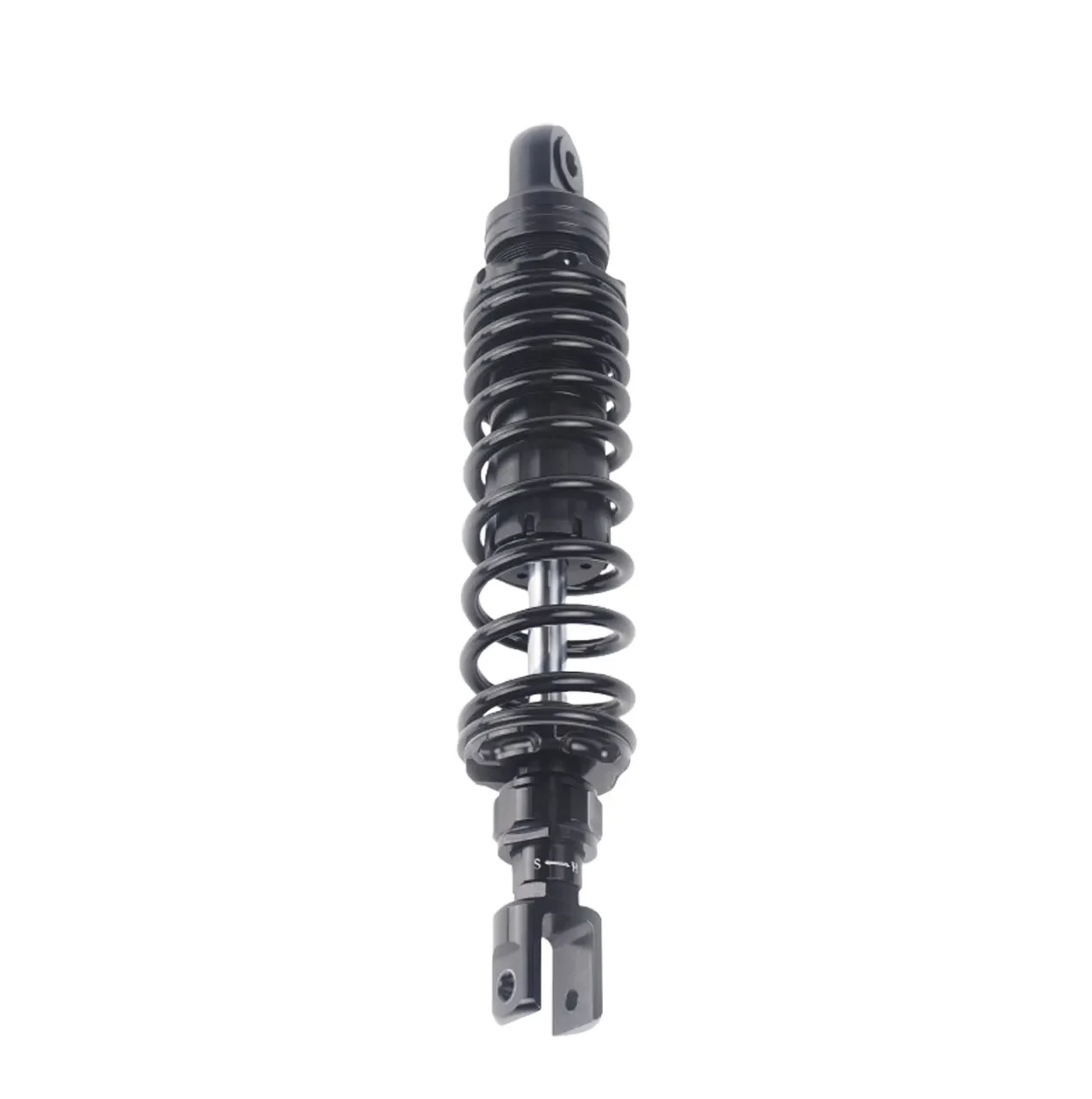
The temptation is to start at the rear, because the rear is familiar. Two coil-sprung shock absorbers with preload adjustable to four positions, as the Piaggio specification lists for both Sprint and Primavera, look like a conventional twin-shock arrangement and respond to conventional thinking. A shop that upgrades the rear first gets an immediate, obvious result — a firmer tail, less squat under acceleration — and the customer is pleased.
But that result is misleading. It changes the balance of the scooter without touching the end that steers. Stiffen the rear and leave the front soft, and the front now works against a rear that resists compression more, so pitch under braking and over bumps shifts in a direction nobody chose. The rider may report that the scooter feels “tippy” or that the front washes on turn-in — a complaint created by the upgrade order, not by the parts.
The second reason is information. The front is where the rider reads the road: steering feel, turn-in confidence, the sense of whether the scooter is planted. Change the front first and evaluate it, and you learn what the chassis wants. Change the rear first and you’re guessing at what the front will need to match.
The sequence that works:
Establish a baseline. Record the current front behaviour on a known route — the same stretch of broken tarmac, the same braking marker, the same turn. Note what the rider complains about specifically.
Change the front only. Fit the selected front unit, set preload to the rider’s weight, and re-run the baseline route.
Evaluate before touching the rear. Does the front now absorb the sharp edges? Is turn-in more or less predictable? Is there any new noise, rubbing or change in ride height?
Then match the rear. Choose the rear spring and damping to complement the front, not to compensate for it. If the front is now controlled, the rear needs to support the same operating weight without introducing a different pitch characteristic.
This order protects the workshop too. A customer who feels a clear front improvement has a reason to come back for the rear. Fit the rear first and then a front that fights it, and the same customer has a reason to complain. Working in sequence makes each step something you can judge, and that’s what a premium upgrade has to be sold on.
One caution on the rear: preload adjusts ride height and sag, not stiffness. As ProMecha’s sag and preload guide puts it, setting sag gives the bike the right compromise for bumps and holes, while preload adjusts sag and ride height rather than spring rate. If a rear unit needs heavy preload to sit at the right height with a passenger aboard, that is a signal about spring rate, not a tuning opportunity — and it is a signal to check before the front is finalised, because the operating weight the front must match depends on it.
Sprint and Primavera Upgrade Paths
Sprint and Primavera share a platform family and a front suspension architecture, but they aren’t the same customer and shouldn’t be sold the same upgrade path. Folding them into one “Vespa small body” recommendation is the most common mistake in dealer catalogue planning, because it produces a single SKU story that suits neither buyer.
The difference is about role, not about which is better. In platform terms, the Sprint is typically positioned as a style-driven commuter with a sport-look upgrade appetite, while the Primavera is positioned as a comfort-driven commuter and premium daily ride. That framing comes from Kingham Tech’s own Vespa platform coverage: the Sprint’s main suspension opportunity is reducing harshness and improving front stability feel, while the Primavera’s is smoothing small bumps and reducing vibration feel, with comfort-first upgrades and premium finish options.
Treat that as where each buyer starts, not as a spec sheet:
Sprint path. The buyer is more likely to notice and value front stability and a firmer, more controlled feel. The front unit is the headline; the rear follows to keep the balance. A rider who has fitted a sportier exhaust, a different seat or cosmetic parts is usually receptive to a front upgrade framed around control rather than plushness.
Primavera path. The buyer values smoothness and quiet over sharpness. The front unit still comes first, but the selection criterion is different: how well it absorbs small, high-frequency imperfections without transmitting them to the bars. The rear is matched for comfort under load, not for a firmer tail.
Choosing by model first means two questions before you open the catalogue: which model is this, and what does the owner actually complain about? A Sprint owner and a Primavera owner can both call the front vague over broken surfaces and still need different front specifications, because they aren’t chasing the same outcome.
Fitment is where discipline pays. Sprint and Primavera have appeared across many displacements, model years and market variants, and a part that suits one configuration isn’t automatically right for another. Kingham Tech’s own platform pages list front and rear references under “Sprint/Primavera 150” as a family — a programme-level grouping, not a per-year fitment guarantee. For a specific bike, confirm the spec pack by model with the supplier before you quote a part. Don’t build a year table from assumption, and don’t infer a customer’s model year from the badge alone.
For distributors, that means a two-line catalogue instead of one: a Sprint-oriented front and rear pairing and a Primavera-oriented pairing, each with its own positioning note. It gives the dealer a reason to stock both — and a script for each customer.
City Roads and Two-Up Use: Choosing by Use
Model decides the path; use decides the specification within it. Three patterns cover most Vespa owners a dealer will see.
Daily city riding, solo. The dominant inputs are short, high-frequency bumps: paving joints, patch repairs, cobbles, kerb ramps. The front works constantly at small amplitudes, and the complaint is usually harshness or the feeling that the bars transmit everything. What you want here is low-speed control and small-bump compliance up front, plus a rear that doesn’t add a second harshness source. Go too firm and the customer reads it as “no improvement”, because the surfaces they ride never ask the suspension for anything else.
Two-up and loaded riding. This is where the choice really matters. A passenger and luggage raise the operating weight a lot, and the suspension has to sit at the right height under that load while still keeping travel to absorb bumps. Penske’s guide to adjusting suspension for weight puts it plainly: a spring that works solo may still have enough preload range for occasional luggage or a passenger, but a bike that regularly carries a heavy passenger and touring load may need a spring built around that weight. The same logic holds on a Vespa, at both ends.
Two-up use also changes the front’s job. With more mass over the rear, the front unloads more readily under acceleration and loads harder under braking, so the front damper has to cover a wider range of conditions. This is where a soft, comfort-only front specification starts to feel vague with the scooter fully loaded. The mechanism — how added mass and a higher centre of gravity change stability under load — is set out in this explanation of why motorcycles feel unstable with a passenger and luggage, and it’s worth a read before you quote a two-up setup.
Longer rides and mixed surfaces. Less common on a small-body Vespa, but real for touring versions and riders who take the scooter out of the city. Here the priority moves toward consistency: damping that doesn’t fade or change character over a long day, and a rear that holds ride height with luggage on board. Comfort still counts, but predictability counts for more.
A rule that works at the counter: ask what the scooter carries in a typical week, not what it might carry once a year. A rider who takes a passenger every weekend needs a different rear spring from one who does it twice a summer, and the front should match the weight the scooter actually runs at. When the answer is unclear, say so — the specification depends on the real operating weight, so confirm it with the supplier instead of guessing.
Before-and-After Checklist
A suspension change is only as good as the check that follows it. This one is written for the shop doing the work, and kept short enough to actually use at the bench.
Before the change
Record the baseline: current front and rear behaviour on a fixed test route, with the rider’s specific complaint written down in their words.
Confirm the operating weight: rider, regular passenger, typical luggage. This drives spring and preload selection at both ends.
Measure and record ride height and sag at both ends, so any change after fitting is measurable rather than remembered.
Confirm the spec pack by model with the supplier for the exact bike in front of you, including variant and model year.
Inspect what is already there: worn bushes, leaking dampers, damaged bump stops, corroded fasteners. An upgrade fitted over a worn component will not deliver the expected result, and the customer will attribute the fault to the new part.
Check tyre condition and pressure. A worn or under-inflated front tyre mimics suspension faults convincingly.
After the change
Ride feel. Re-run the baseline route. Compare against the recorded notes, not against memory. Look for the specific improvement the customer asked for, and note anything that got worse.
Braking behaviour. Test progressive braking from moderate speed on a clear surface. The front should compress and recover predictably, without a sudden dive, a knock or a change in steering feel mid-braking.
Clearance. Check the front link, spring and damper through full compression and extension, and check the rear against the bodywork and exhaust with the scooter loaded as it will be used. Check cable and hose routing at full lock both ways.
Fastener and torque check. Re-verify all mounting points after the first test ride, not only at installation.
Ride height and sag. Re-measure and compare with the baseline. A change in ride height changes steering geometry, so it needs to be a deliberate result, not a side effect.
Noise. Listen for new noises over the roughest part of the route — a knock, a squeak or a rub that was not there before.
What to take back to the dealer or supplier
If the result isn’t right, the useful report is specific: model and variant, the part fitted, measured ride height and sag before and after, the exact conditions where the problem shows up, and whether it happens solo, two-up or both. A vague “it feels wrong” can’t be diagnosed. A recorded baseline, a measured change and a described condition can. If the issue points to a specification mismatch rather than a fitting fault, confirm the spec pack by model with the supplier and, if needed, revisit spring rate for the real operating weight instead of winding on preload to compensate.
Conclusion
If there’s one thing we’d want a dealer to take from this, it’s the order of work. The single-sided front defines how the scooter feels, so sort it first — and because it’s a single load path with nothing to dilute a change, the specification of that one unit matters more than the price on the box. Get the front right, judge it honestly, then match the rear to the weight the scooter actually carries.
Model and use then narrow the choice. Sprint and Primavera are separate paths with different buyers and priorities, and city riding, two-up duty and longer journeys each shift what the front and rear need to do. Fitment is where assumption gets expensive: confirm the spec pack by model for the exact bike, and record the baseline so the result can be judged rather than guessed at.
For dealers, shops and distributors building a Vespa programme, the starting point is the model range itself. Review our Vespa Sprint 150 and Primavera 150 suspension coverage to see how the platform is grouped, then consult us on fitment and spares for the specific models and model years you carry — we’ll confirm the specification for your market rather than leave it to a catalogue guess.