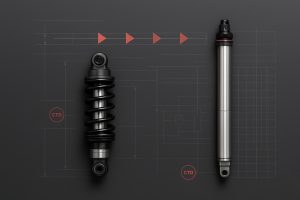








A motorcycle can feel planted when ridden solo, then turn vague, floaty, or nervous the moment you add a passenger and luggage. If you’ve ever wondered “why does my motorcycle feel unstable with a passenger?” or noticed a loaded motorcycle wobble after adding luggage, the important point isn’t that “two-up riding is harder.” It’s that payload is a system input—and once it pushes the suspension and chassis beyond their stable operating range, small road disturbances stop dying out quickly.
In engineering terms, this is load-induced suspension instability: the system is operating in a different part of its envelope, with less margin to absorb real-world inputs.
Load doesn’t create new instability—it pushes the system beyond its stable operating range.
This article explains what changes under load, why the symptoms cluster the way they do, and how OEM/ODM program engineering and supplier validation groups can correct the problem systematically—without relying on consumer-style setup numbers or model-specific tuning recipes.
Motorcycle suspension instability under load
If you’re doing platform evaluation or supplier selection, this is the question behind many “unstable when loaded” field reports: does the chassis still have adequate stability margin at the loaded design point?
Load-induced instability is a loss of stability margin caused by a meaningful increase in total mass and (often) a rear-biased center of mass. In real riding, that shows up when a disturbance—an expansion joint, a series of rolling undulations, a mid-corner bump—doesn’t decay the way it does in the baseline condition.
Three things usually explain why this catches teams off guard:
Baseline stability is not the same as stability under load. A platform can be stable in its “design point” condition while being marginal in other parts of the operating envelope.
Load moves the suspension operating position. If the suspension sits deeper in stroke for long periods, it changes both geometry and the damper’s working regime.
Load is rarely applied “cleanly.” Passenger posture, luggage placement, and aero add-ons introduce variability that controlled testing often doesn’t represent.
So the right mental model isn’t “the bike becomes unstable.” It’s: the system is being run in a different part of its envelope, with different margins.
Unlike high-speed instability dominated by aerodynamic and dynamic effects, load-induced instability is often a static-to-dynamic transition problem: added mass and distribution shift the starting point, and the suspension then has less margin to absorb real-world inputs.
For OEM validation and engineering groups, this isn’t a rider-complaint issue—it’s a validation and system design constraint.
Common symptoms of instability under passenger and luggage load
Symptoms are your first “screening signal” that the loaded configuration is operating with reduced margin (ride height, damping authority, or thermal consistency).
Even when field reports describe the issue differently, the symptoms tend to cluster around the same system behaviors. In voice-of-customer language, this is often described as a “floaty rear,” a “nervous front,” or simply “unstable when loaded.”
Rear suspension “float” or a loose feeling after bumps
The rear can feel like it’s reacting a beat late—compress, rebound, then continue moving when the chassis should already be settled. This is often reported as floating, wallowing, or disconnected.
Instability in long sweepers when fully loaded
Under sustained cornering, an under-controlled chassis can drift off line or require continuous corrections. It’s not always a sharp “shake”; more often it’s a low-frequency, hard-to-pin-down movement.
Front-end lightness under acceleration
When load is rear-biased and the rear ride height drops, the front can feel less planted—especially during roll-on events that unload the front contact patch.
Delayed recovery after repeated road inputs
A single bump might be acceptable, but a sequence of inputs (wavy pavement, repeated joints) can “stack” motion. That’s a clue that the system’s decay behavior isn’t fast enough for the input frequency it’s seeing.
How load pushes the system beyond stability limits
The core question is: what changed in operating position, energy per event, and control authority when you moved from solo to the loaded duty case?
The fastest way to diagnose load-induced instability is to stop looking for a single “bad part” and instead track how load affects four system variables.
This is where most diagnostics go wrong: teams chase symptoms instead of checking whether the system still has margin in the loaded condition.
At this point, it’s important to separate rider symptoms from system-level variables.
From a system perspective, load affects four primary variable groups: geometry (ride height/sag), damping (energy decay), mass distribution (rear bias), and thermal behavior (fade).
Here’s the shortlist:
1.Increased sag reduces available travel and stability margin
More load typically increases sag. That does two things that matter for stability:
It consumes travel that the system needs for disturbance absorption. You have less margin before hitting end-of-stroke behavior.
It changes chassis attitude and geometry. A meaningful shift in ride height changes the balance of self-stability and responsiveness.
The key isn’t a target number. The key is whether the platform is operating with enough travel and enough geometry margin under the real load case—the condition riders describe as “unstable when loaded.”
2.Preload mismatch puts the suspension in the wrong operating position
Preload is commonly treated as “make it stiffer,” but that’s not what it is. As Penske explains in their 2022 article on what spring preload does (and doesn’t do), preload primarily shifts ride height and sag—it doesn’t change spring stiffness.
Sag matters because it changes where the suspension sits in its travel and how it responds to braking, cornering, and bumps. Penske also frames sag as an essential baseline in their 2022 overview of why front suspension sag matters.
In system terms, preload mismatch is a bias error: the suspension is asked to do control work while sitting in a suboptimal part of stroke.
It’s worth separating two variables that get blended in casual conversation: spring rate is a fixed physical property of the spring—how much force it takes to compress it a given distance—while preload is an adjustable setting that shifts where the suspension sits in its travel (sag) without changing that rate. A platform can have the correct spring rate for its target load and still behave badly under passenger-and-luggage duty if preload isn’t set to restore proper sag; conversely, no amount of preload adjustment can compensate for a spring rate that’s fundamentally too soft for the loaded duty cycle—at that point preload becomes a workaround, not a fix.
3.Damping designed around solo use becomes under-capacity under higher mass
When total mass increases, the system can carry more energy into each compression/rebound event. If damping authority (and balance) isn’t sufficient in the relevant velocity regions, disturbances don’t decay quickly.
A simple way to phrase this for platform work: under load, you’re not only changing how much the suspension moves, you’re changing how much energy the damper must dissipate per event.
4.Rear-biased load amplifies oscillation tendency
Two-up and touring payload is rarely centered. That rear bias matters because it changes chassis attitude and can reduce front-end margin. It also increases the likelihood of slow, rear-led oscillations under long-duration inputs, and it makes the platform more sensitive to luggage placement and aero effects.
This is why load-induced instability often feels like a system-level “wobble” rather than an obvious mechanical fault.
Why touring and two-up conditions expose instability in duty-cycle testing
In test planning, “touring / two-up” should be treated as a defined duty case (mass, distribution, road input profile, and temperature), not as an informal rider scenario.
The “touring case” isn’t just more weight. It’s a different operating regime.
Sustained load keeps the suspension deeper in stroke
Short rides with transient load changes can mask the issue. Touring keeps the system biased for hours, so any mismatch in operating position becomes persistent.
Long-distance riding increases thermal sensitivity
As heat builds in the damper, viscosity changes and gas/oil dynamics can shift. A system that’s stable when cold can still drift as temperature rises. That’s why damping consistency over temperature becomes a limiting factor.
Payload + heat reduces effective damping consistency
For engineering evaluation, the question is not “does it feel good now?” It’s “does it behave consistently after repeated high-energy inputs over sustained duration?”
Luggage and aerodynamics increase sensitivity
Cases, top boxes, and touring add-ons can change aerodynamic loading and yaw sensitivity—a pattern that shows up clearly on heavily loaded touring and adventure platforms like Royal Enfield. That doesn’t “cause” instability by itself—but it can reduce the headroom you thought you had.
Taken together, these effects are exactly why “two-up touring” needs to be defined and signed off as an engineering input—not left as an informal rider scenario.
Why load setup often fails in real use and OEM validation
If you’re hearing repeated complaints like “unstable with passenger and luggage,” it often traces back to a validation gap: the loaded configuration wasn’t defined, instrumented, and signed off as a first-class requirement.
Teams usually fail load stability for predictable reasons.
The baseline condition is treated as universal
If the platform is validated mainly in a nominal condition, the real-world load cases become edge cases—even though they may be common in the field.
Load cases aren’t defined as engineering inputs
If “two-up touring” isn’t defined as a testable configuration (mass, distribution, duty cycle, temperature expectations), it’s impossible to design to it.
Front–rear balance shifts without compensation
Small changes in ride height and operating position can shift the handling balance. Without a deliberate balance target, the platform drifts into “it depends” territory.
Luggage distribution is ignored
Two loads with the same total mass can behave differently if one is high and rearward. If distribution isn’t part of the definition, stability becomes inconsistent.
How to correct load-induced instability
The goal is a repeatable, documentable process that holds up across prototypes, suppliers, and production drift—not a one-off setup fix.
This section covers the process. The next section covers the point where the process is sound, but the hardware still can’t deliver enough control under load.
A platform-level process that produces defensible conclusions.
Step 1: Define the real operating load cases (not just “two-up”)
Define load cases the way you’d define a test condition:
representative total payload range
typical distribution (passenger position, luggage placement)
duty cycle (duration, repeated input profile)
temperature expectations (steady-state vs transient)
If the load case isn’t defined, everything downstream is guesswork.
Step 2: Restore the suspension operating position under the real load case
You’re not chasing a specific sag number. You’re trying to avoid running the bike “buried” in stroke, so you keep enough travel and geometry margin in the loaded condition.
Use preload and spring support as operating-position tools—but keep a hard boundary in mind: as Penske notes, preload can only compensate so far before it becomes a workaround for an incorrect spring choice (see the Penske discussion cited earlier).
Step 3: Validate decay behavior under repeated inputs
A stable system doesn’t just survive an input—it damps it out. What you’re validating is the decay rate and whether motion is accumulating.
In practice, this means evaluating:
whether oscillations die quickly after a disturbance
whether repeated inputs produce “stacking” behavior
whether the rear feels like it returns with authority (without overshoot or lingering motion)
This kind of unresolved motion is sometimes called rebound overshoot—when the wheel extends past its resting point after a disturbance instead of settling directly, adding another cycle of oscillation before the system actually decays.
This is where damping capacity and balance show up.
Step 4: Check thermal consistency as a first-class requirement
If the ride changes meaningfully as the system heats, that’s not rider sensitivity—it’s a design constraint.
When you evaluate suppliers or internal solutions, insist on validation artifacts that show behavior across temperature and time. Kingham Tech describes an engineering approach to dyno validation artifacts and repeatability windows (including cold vs. hot curve comparison and acceptance bands) that can be used as a template for what “validated” should mean—and that can carry the same acceptance bands from prototype through serial production, rather than stopping at the first good curve.
A defensible validation run typically specifies the test rig and mounting arrangement, the dyno sweep settings and velocity range, the temperature bands and soak duration, and the acceptance criteria (decay rate or overshoot limits, plus allowed curve deviation) agreed upon before testing begins. Recording all four is what turns a single good result into a repeatable one—and it is what lets a supplier, a prototype, and a production unit be compared on the same terms.
This guidance is written for professional engineering and OEM/ODM validation contexts. It is not a consumer setup guide, and any change to suspension hardware or settings on a road-going motorcycle should be carried out and verified by qualified personnel against the vehicle manufacturer’s requirements.
When suspension hardware becomes the limiting factor under load
At that point, the “setup knobs” are no longer the bottleneck. The limiting factor is whether the damper and spring system can deliver consistent control across the loaded duty cycle.
Once the operating position is reasonable and the behavior is still unstable, it’s often because the hardware can’t supply the required control over the required duty cycle.
Three common constraints:
Damping authority is insufficient in the relevant velocity regions
If the damper can’t generate adequate control where the platform actually lives (not just at a single test point), motion will persist.
Thermal fade becomes a stability problem, not a comfort problem
Fade isn’t only “it feels softer.” Under load, fade can shift the system from stable decay to slow oscillation.
Adjustability range is too narrow for the load envelope
If the stock system has limited adjustment or a narrow tuning window, it can’t be made stable across real load distributions—especially once you include temperature and repeated inputs.
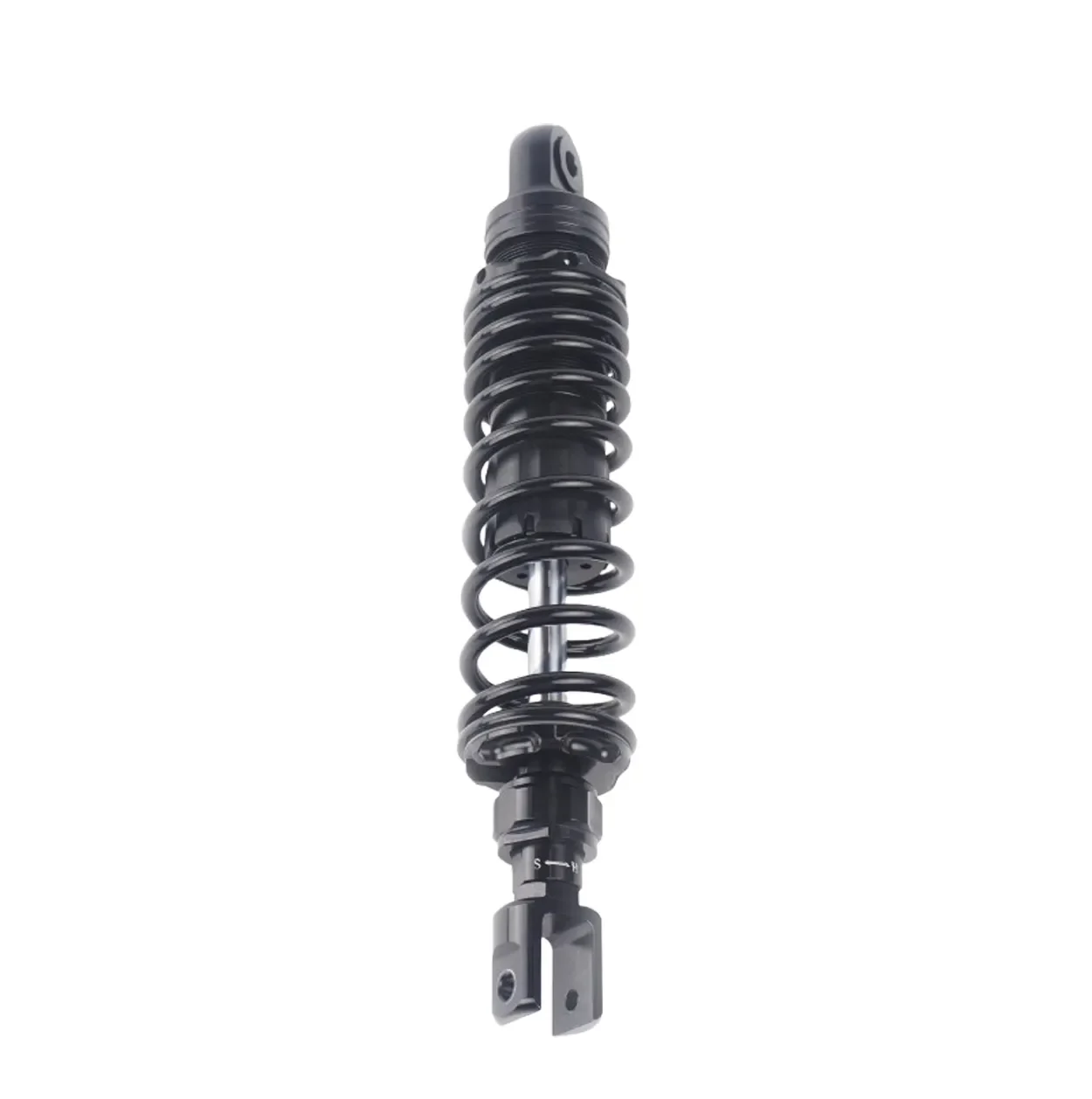
This is exactly the profile a load-rated rear shock absorber is designed to solve—more damping authority and a wider adjustment range across the specific velocity regions a loaded, touring duty cycle actually sees, so the damper can be specified to the load envelope rather than tuned around it.
Why stock suspension struggles with real-world load cases
This is a common root cause behind “loaded motorcycle instability” reports: production suspension is usually tuned around a nominal rider and broad comfort expectations. That’s not “bad engineering.” It’s a trade-off.
The failure mode is when that trade-off meets a load envelope it wasn’t designed or validated for:
average-weight assumptions don’t match two-up + luggage duty cycles
comfort tuning can reduce control margin under high-energy inputs
controlled testing may not reproduce the worst-case combination of load distribution, road input frequency, and temperature
That’s why platform programs benefit from defining the envelope first and validating against it—rather than treating instability complaints as isolated anomalies. Where formal traceability is required, it also helps to align the load-case definitions and decay measurements with established vehicle-dynamics test practice (for example, the SAE and ISO standards families covering road-vehicle dynamic testing and measurement), so that internal gates and supplier sign-offs reference a common, auditable baseline.
How load instability connects to high-speed wobble and weave modes
From a validation perspective, this is the escalation path you want to prevent: a configuration that’s acceptable solo but becomes marginal when loaded can drift toward wobble/weave thresholds. As a rule of thumb for diagnosis: if instability only shows up solo or at highway speed, you’re likely dealing with a wobble or weave mode—see High-Speed Wobble and Weave: How Suspension Design Fixes Instability for that system-level breakdown. If it only shows up with a passenger or luggage on board, the cause is almost always load-induced, not a platform defect, and the diagnostic path below applies.
The bridge is straightforward: load often reveals instability modes that were already close to the threshold.
increased sag can reduce stability margin
rear-biased load can increase sensitivity to low-frequency, rear-led oscillation
under-capacity or inconsistent damping can turn a disturbance into a sustained motion
In many cases, load doesn’t create instability—it reveals it.
Stability requires load-aware system design
Load-induced instability is not a single-component defect. It’s a system behavior that emerges when payload shifts the platform outside its validated operating envelope.
You’ll know the load case has been engineered rather than just tuned when the platform clears the same loaded, heat-soaked test on repeat: no accumulating motion after successive inputs, no unexpected ride-height drift over a long stint, and no thermal fade beyond the spec you defined in Step 4. That repeatability is what separates a validated program from a setup that only feels right until conditions change.
FAQ
A few of the field questions that come up most often:
Why does my motorcycle feel unstable with a passenger?
Extra weight increases sag and shifts where the suspension sits in its travel, which changes both geometry and how much energy the damper has to control per event. If the setup wasn’t validated for that loaded condition, disturbances stop decaying as quickly as they do solo.
Does a heavier passenger always cause instability?
Not by itself. Weight only becomes a problem when it pushes the platform past the margin it was validated for—how it’s distributed, how long the load is sustained, and whether damping and preload were set for that condition all matter as much as the total mass.
Can I fix load-induced instability just by adjusting preload?
Only partly. Preload restores ride height and sag, which helps if the platform sits too deep in its stroke. But if the spring rate itself is too soft for the loaded duty cycle, no amount of preload adjustment will fully resolve the instability.
What is overshoot in motorcycle suspension?
Overshoot shows up as a secondary bounce or “kick” right after the initial hit, instead of the suspension settling in one smooth motion. If you’re feeling that on a loaded bike, it usually points to rebound damping that hasn’t been re-tuned for the added mass—see the validation steps above for how to check it systematically.
Next steps
If you’re evaluating changes or an OEM/ODM partner, use a validation-first lens:
Ask for force–velocity curves, hot/cold comparison, and repeatability windows.
Require a documented gate process from prototype to SOP to prevent drift.
If you want to sanity-check your load cases, validation artifacts, or supplier requirements for this kind of stability issue, the next step is a working session rather than more general advice.