

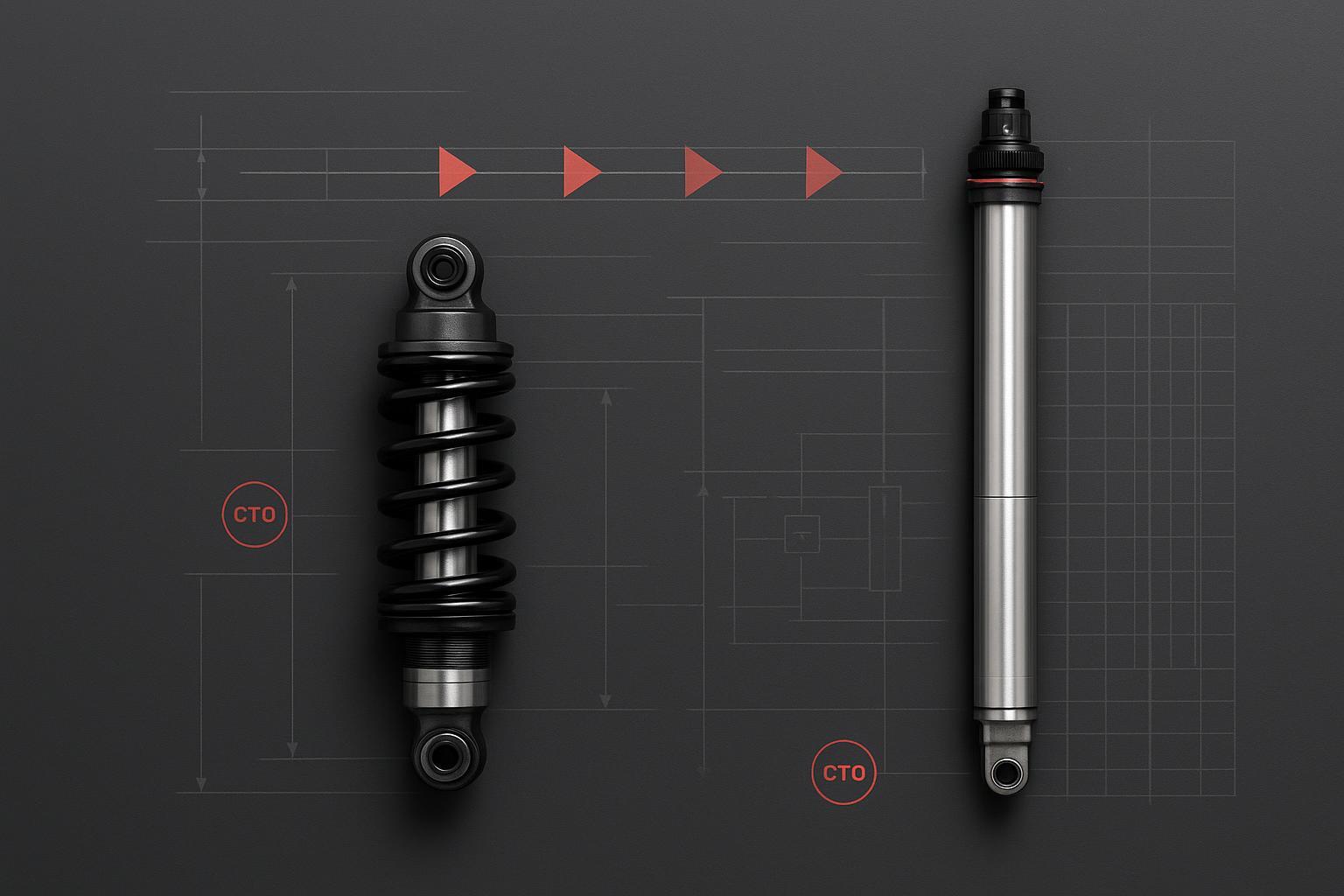
Prototype performance can look perfect on a dyno and still collapse at SOP (Start of Production). That failure isn’t “bad luck.” It’s usually a missing system: requirements that never became CTQ (Critical-to-Quality characteristics), validation that proved the product but not the process, and manufacturing controls that were never engineered.
If you’re engineering or procurement evaluating an OEM supplier, the real question behind any motorcycle suspension OEM development process is simple:
Can this supplier repeatedly build the same damping curve, durability, and appearance—batch after batch—under SOP conditions?
A Procurement-First Decision Layer: What to Do Before You Commit
Most readers don’t come to this topic to learn APQP. They come because they need to make a decision under time and risk pressure: keep the current supplier, switch, or qualify a second source.
Here’s a practical way to use the motorcycle suspension OEM development process as a decision tool.
The 3 questions that decide whether you’re SOP-safe
Is the performance target measurable as CTQs? If not, you’re buying “ride feel,” not a controllable spec.
Is the process validated (not just the product)? If not, prototypes can pass while production drifts.
Can the supplier prove control in batch behavior? If not, SOP is a gamble.
Fast if/then rules procurement teams can use
If CTQs aren’t frozen, then avoid tooling commitment and lock a CTQ matrix first.
If SOP is within 6 months, then prioritize suppliers that can show production-intent trial builds and controls.
If warranty risk is high, then require process evidence (control plan + MSA + traceability) as part of supplier acceptance.
Decision takeaway: You’re not choosing a “good prototype.” You’re choosing a supplier who can provide repeatable proof under SOP conditions.
Why Most Motorcycle Suspension OEM Programs Fail Before SOP
Prototype success does not guarantee production stability
A prototype is built under ideal conditions. It proves the design can work.
SOP is a different test. Variation comes from operators, fixtures, tool wear, incoming lots, and throughput pressure. If you don’t validate the process under those realities, “good prototypes” turn into unstable production.
The hidden gap between validation and manufacturing reality
Many teams run “validation” as a single bucket: if the bike rides well and survives a test, the program is “validated.”
In APQP (Advanced Product Quality Planning) and PPAP (Production Part Approval Process) language, that’s mixing product validation with process validation. Product validation answers: does the suspension meet the performance intent? Process validation answers: can we manufacture it repeatedly with controlled variation?
This distinction is why the AIAG frames quality as an integrated system of tools—APQP, PPAP, Control Plan, FMEA, MSA, and SPC—rather than a single test report (AIAG Quality Core Tools).
Why “ride feel tuning” cannot define scalable production
Decision checkpoint
What it means (engineering): “Ride feel” must be translated into measurable CTQs and held by a validated process.
Why it matters (risk): If the spec stays subjective, you’ll argue opinions while batch drift turns into field failures.
What you should decide (procurement action): Treat “ride feel” as input language only. Freeze CTQs + acceptance methods before you approve tooling, PPAP evidence, or launch inventory.
“Ride feel” matters. But it’s not a production contract.A scalable OEM program needs measurable targets that correlate to ride feel and durability—then a manufacturing system that can hold those targets. If “it feels right” is the spec, you’ll end up debating opinions while batch variation keeps leaking into the field.
What a Real OEM Motorcycle Suspension Development Process Includes
Requirement definition vs engineering interpretation
OEM requirements often arrive as mixed inputs:
vehicle platform constraints (packaging, mounting, stroke)
performance targets (handling, comfort, stability)
durability targets (load cycles, thermal conditions, corrosion)
appearance constraints (anodizing color, surface finish)
regulatory and audit expectations
The supplier’s job is not to “agree.” It’s to translate those inputs into engineering targets that can be designed, measured, and controlled.
CTQs as the measurable contract between OEM and supplier
CTQ (Critical-to-Quality characteristics) are the measurable characteristics that both sides agree will define success. A CTQ is only decision-grade when it answers four questions:
What are we measuring?
What is the acceptable window?
How and how often is it measured?
What is the out-of-spec rule and reaction?
In other words: CTQs prevent a program from being managed by interpretation.
If a requirement cannot be mapped to a CTQ, it cannot be controlled at SOP.
If the CTQ list doesn’t include a method, sampling frequency, and a reaction rule, you don’t yet have acceptance criteria you can enforce at launch.
Four system layers: packaging, performance, durability, appearance
A reliable development process treats suspension as a system with multiple CTQ layers:
Packaging CTQs: mounting dimensions, stroke, installed length, clearances, hose routing (if applicable).
Performance CTQs: damping force-velocity curve windows, hysteresis, friction band, response consistency.
Durability CTQs: fatigue life under defined duty cycles, seal life, corrosion resistance, leakage limits.
Appearance CTQs: coating thickness windows, anodizing consistency, cosmetic defect limits.
A supplier can “win” on performance in prototypes and still fail SOP because packaging measurements were repeatable but assembly controls were not—or because appearance CTQs were never turned into a controlled finishing process.
Which OEM Supplier Type Fits Your Timeline and Risk?
A common failure mode in sourcing is selecting a supplier whose capabilities match prototype work but not SOP control. Use this quick decision map before you invest in tooling, validation time, and launch inventory.
Your situation | What it usually means | What to avoid | What to require instead |
|---|---|---|---|
SOP timing is tight (e.g., < 6 months) | You don’t have time for “learning in production” | Prototype-only development with unclear controls | Production-intent trial builds, defined CTQs, and a control plan with reaction rules |
CTQs are still vague or changing | Specs are not yet contractable | Early tooling commitment | CTQ matrix first, with measurement methods + decision rules |
Warranty/field failure risk is high | You’ll pay for drift, not just defects | “Dyno graph as proof” without process evidence | MSA-backed measurements, traceability, and containment/reaction plans |
Multiple vehicle variants/markets | Variation management is the real challenge | One-off tuning samples | Change control, sampling triggers, and repeatable dyno methods |
Decision takeaway: A supplier’s “capability” only matters if it matches your timeline and risk profile—not just your dyno target.
Stage-Gated Motorcycle Suspension OEM Development Process (Engineering-Controlled Model)
Below is a stage-gated model that separates product validation from process validation and forces CTQ discipline early. It’s written as a practical backbone you can adapt for a motorcycle suspension OEM development process and still keep it auditable. It aligns with the spirit of APQP and the evidence expectations behind PPAP (InspectionXpert on APQP vs PPAP).
For OEM programs, this framework only works if the supplier can actually execute it on a real line: stable machining, controlled finishing, consistent assembly steps, and measurement discipline. That’s why you should always ask what’s done in-house (machining, anodizing/finishing, lab testing), which quality systems govern the work (e.g., IATF/ISO), and how CTQs are verified at each gate—not just what the prototype looks like.
Stage 1: Requirement definition and CTQ mapping
Inputs
OEM requirement pack (vehicle constraints, targets, environment)
baseline architecture (shock type, reservoir, adjusters)
Actions
translate requirements into a CTQ list (packaging / performance / durability / appearance)
define measurement methods and acceptance windows
pre-align what is “must meet” vs “tradeable”
Outputs
CTQ matrix with definitions, measurement method, and responsibility
Done when…
every requirement has an owner, a measurement method, and a decision rule
Stage 2: Early validation (fitment, measurement, repeatability)
This stage is about making sure you can measure reality—before you tune it.
Actions
fitment confirmation on representative vehicles
measurement repeatability check for key dimensions
baseline dynamometer testing (dyno) method setup: same fixtures, warm-up, temperature, oil state rules
Outputs
repeatable measurement procedure for packaging and dyno outputs
Done when…
the same unit measured twice (or by two operators) returns materially consistent results
Stage 3: Prototype calibration and tuning alignment
Now you tune—but you tune against CTQs and a measurement system.
Actions
iterate valving, spring, and gas/oil configuration to hit CTQ windows
align on “ride feel” language by linking it to measurable outputs (force curve shape, low-speed friction band, etc.)
Outputs
prototype build spec and tuning intent that can be re-built, not re-invented
Done when…
the tuning outcome is reproducible across multiple prototype units, not a single “golden sample”
Stage 4: Process validation (not product validation)
MUST-PROVE for SOP acceptance
If Stage 4 evidence is weak, you’re in a HIGH-RISK SOP DRIFT ZONE. The product can be “good,” but the process won’t hold it.
A practical procurement filter is simple: no process validation evidence means no SOP-ready decision.
This is where many programs skip—and where SOP failure is usually born.
Process validation proves that the manufacturing process can hold CTQs. It is operationalized through a control plan and its dependencies: PFMEA logic, measurement discipline (MSA), and reaction plans.
In APQP/control-plan practice, a control plan defines what is controlled, how it is measured, and what happens when it drifts (Intertek on APQP and Control Plan).
A control plan is the supplier’s written promise for how they will prevent drift, detect drift, and contain drift—so you can treat it as acceptance evidence, not just internal documentation.
Actions
define process steps and critical controls (assembly, filling, charging, torque, finishing)
run trial builds using production-intent tooling, fixtures, and operators
perform MSA (Measurement System Analysis) on gauges and measurement methods used for CTQs
Outputs
process control plan tied to CTQs with clear reaction plans
Done when…
the process can repeatedly hit CTQs with defined monitoring and containment rules, not “hero operators”
Decision checkpoint
What it means (engineering): Process validation proves the line can hit CTQs using production-intent people, tooling, fixtures, and measurement systems.
Why it matters (risk): Without it, your “approved sample” is just a one-off—and your SOP batches become the real experiment.
What you should decide (procurement action): Make Stage 4 evidence a GO/NO-GO gate. If the supplier can’t show control plan + MSA + trial builds, treat them as not SOP-ready yet.
Stage 5: SOP readiness and batch stability confirmation
GO/NO-GO launch gate
SOP readiness is a purchasing decision as much as it is an engineering milestone. The launch question is binary: will CTQs stay stable across batches, shifts, and lots—or not?
SOP readiness is proven by batch behavior, not a single build.
Actions
batch sampling plan (including dyno sampling windows)
traceability rules from incoming components to finished units
deviation management: containment, root cause, and correction loops
Outputs
SOP gate package: CTQ list, control plan, MSA evidence, traceability schema, reaction plan
Done when…
the first SOP batches show stable CTQ distribution and predictable reaction behavior when drift occurs
Decision checkpoint
What it means (engineering): SOP readiness is proven by batch distribution and repeatable reactions to drift.
Why it matters (risk): Launch inventory amplifies variation. If drift appears after SOP, your cost shows up as rework, line stops, and warranty exposure.
What you should decide (procurement action): Make traceability + sampling triggers + deviation containment part of the sourcing contract, not an afterthought.
Production Control System for Stable Suspension Manufacturing
CTQ-based control plans for manufacturing stability
A control plan converts CTQ intent into manufacturing controls: what you measure, at what frequency, by what method, and what you do when it’s out.
In automotive practice, control plans are a core element that ties APQP planning and PPAP evidence together (symestic control plan overview).
For suspension manufacturing, typical CTQ-linked controls often include (examples—not universal specs):
oil fill volume / bleed process controls
nitrogen charge pressure verification
torque values + torque sequence controls
valving stack build verification (shim count/thickness, stack height)
piston rod seal friction checks (where applicable)
rod surface finish and straightness checks
coating/anodizing thickness windows
Dyno sampling strategy for batch monitoring
Dyno sampling is only decision-grade if the method is repeatable and the sampling triggers are defined. Otherwise, the dyno becomes a marketing artifact, not acceptance proof.
Dynamometer testing (dyno) is valuable—but only if it’s treated as a control system, not a marketing graph.
A practical dyno batch-monitoring approach typically includes:
defining which points on the force-velocity curve are CTQ (not the entire curve)
defining sampling triggers (new lot, new operator, fixture maintenance, process change)
defining drift thresholds and reaction plans
If your dyno method is not repeatable (fixtures, temperature, warm-up, oil state), you will chase noise and misdiagnose drift.
Traceability from components to finished units
Traceability is what turns field failures into actionable engineering feedback.
Minimum expectations for SOP stability:
lot traceability for key components (seals, shims, oil, coatings)
build record traceability for assembly steps (fill, charge, torque)
finished-unit identification (serial / batch) and linkage to measurement records
Reaction plans when process deviation occurs
A control plan without reaction plans is documentation—not control.
When CTQ drift is detected, the supplier should be able to show a defined path:
contain the suspect lot
verify measurement system validity (MSA check, calibration)
identify root cause (process step + cause mechanism)
implement corrective action and verify via re-sampling
document change and prevent recurrence
This is the practical difference between “we check quality” and “we control production.”
How Engineering + Procurement Teams Should Evaluate OEM Capability
At sourcing time, don’t ask for opinions. Ask for evidence.
A supplier is SOP-capable only if they can show:
a CTQ mapping from requirements (including measurement method + reaction rule)
process validation using production-intent tooling, fixtures, and operators
MSA evidence for the CTQ-linked measurement systems
a control plan with traceability and clear containment/reaction steps
If the conversation stays at “ride feel,” prototype dyno graphs, or one-off golden samples, you don’t yet have an SOP-ready decision.
From Engineering Opinions to Controlled OEM Systems
Scalability depends on process, not design.
A strong damping curve in a prototype is necessary—but SOP success is defined by whether CTQs are measurable, controlled, and stable under real production constraints.
If you want to reduce warranty exposure and rework risk, evaluate suppliers through that lens: CTQ mapping, process validation discipline, measurement integrity (MSA), and production control systems that include traceability and reaction plans.
If you already have an RFQ requirement pack, you can use this article as a checklist—then ask the supplier to walk you through their CTQ list, control plan approach, and SOP stability evidence.
Evidence checklist: what a SOP-ready supplier should be able to show
Ask for a short “launch evidence pack” that includes:
CTQ matrix (definition, tolerance, method, sampling, decision rule)
Process flow + control plan with reaction plans
PFMEA logic for key process risks (assembly, fill/bleed, charging, torque, finishing)
MSA summary for CTQ-linked measurement systems
Traceability approach (critical components → build record → finished unit)
Dyno sampling strategy (what points are CTQ, what triggers extra sampling)
If you want a second set of engineering eyes on that process, start with the Kingham Tech OEM/ODM partner overview—we can provide the same type of evidence package as part of OEM/ODM cooperation—or review the stage-gated approach in OEM/ODM lifecycle management.