

OEM suspension programs often look rock-solid during development: the prototype lands on the target damping curve, the dyno plot is clean, and early ride reports feel reassuring.
Then SOP happens—the moment the line has to repeat that result at volume—and the same program can start bleeding time and credibility: inconsistent damping feel from batch to batch, early leakage complaints, uneven warranty signals across regions, and constant sorting at the receiving dock.
It’s not hard to build a great prototype. It’s hard to keep production centered and stable week after week.
Why OEM suspension programs look successful in development but fail after SOP
This is the core pattern behind motorcycle suspension OEM program failure after SOP: the design may be validated, but the manufacturing system isn’t proven to hold CTQs batch after batch.
Prototype success is not production readiness
Hand-built samples are usually built by your best people under your best conditions.
Parts are often hand-selected.
Processes are slower and more controllable.
Engineering attention is continuous.
Tooling is new, and fixtures are not worn.
That’s why prototype units can be excellent while the production system is still immature.
Prototype ≠ scalable system.
SOP introduces real-world variation that prototypes never test
Once the line runs for volume, you expose variables that were muted or absent during development:
operator-to-operator differences across shifts
material lot variation as procurement expands
fixture wear and tooling drift over time
line-speed pressure that changes how assemblies are executed
A good reference point is how manufacturing teams distinguish validation stages: early validation proves the design intent; production validation proves the system can repeat output at scale (see Formlabs’ overview of EVT/DVT/PVT and mass production validation). In other words: prototype vs production validation suspension logic is about proving the system, not the hero sample.
Production environment changes everything.
The real failure point is consistency, not performance
A single dyno curve can be “right” while the batch is unstable.
One unit can be tuned to perfection.
A batch tells you whether the process is centered and controlled.
Field quality is the result of distribution, not the best sample.
Stability > peak performance.
The core issue is system variability, not suspension design
Supply chain fragmentation creates hidden inconsistency
In emerging markets, “the supply chain” often isn’t one chain. It’s a multi-tier network with uneven standards.
Common instability drivers include:
multi-tier outsourcing (Tier 2 and Tier 3 changes you can’t see)
non-uniform sourcing for the same part number
inconsistent upstream process controls and acceptance logic
Even when drawings don’t change, lot-to-lot variation is a real, standard source of variation in production systems. Accendo Reliability explicitly lists lot-to-lot variation as a distinct category because inputs are not identical across batches.
Variation starts before assembly.
Cost pressure reduces process discipline
Emerging-market programs typically have aggressive cost targets and frequent price-down cycles. When cost becomes the dominant KPI, process discipline degrades in predictable ways:
inspection shortcuts under pricing pressure
reduced process control to increase output
efficiency prioritized over stability
Cost optimization often creates quality instability.
Production knowledge is not aligned with engineering intent
Engineering capability concentrates in the prototype phase.
In production, the work shifts to a different reality:
the assembly sequence is optimized for throughput
controls are simplified to keep the line moving
decisions are made under schedule pressure
Design intent ≠ manufacturing execution.
Why suspension problems amplify during scaling
Small process deviations become large field issues
Suspension is sensitivity-driven. Small process shifts can create big differences in feel and durability.
Examples:
minor changes in damping force at key velocities can show up as instability or harshness
small sealing variation can become leakage, then oil loss, then damping fade
This is the same basic mechanism that makes suspension tunable in the first place: hydraulic damping depends on flow restrictions and valve behavior (UTI’s overview of motorcycle suspension systems explains the hydraulic damping principle and shim-based cartridges at a high level).
Suspension is highly sensitivity-driven.
Batch-to-batch variation drives most real failures
A typical failure arc in OEM programs:
first batch acceptable
later batches drift as tooling wears, suppliers change, and throughput increases
field complaints arrive after scaling
That’s why batch-to-batch variation shock absorber behavior is the signal to watch. It tells you whether your approved sample represents a controlled distribution or a one-off win.
SOP reveals hidden variability.
Scale exposes weak process control
If your output depends on who built the unit, you don’t have a process—you have a dependency.
Scaling requires controls that survive shift changes, tool wear, and line-speed pressure.
Why “good samples” do not guarantee OEM success
Suppliers optimize for sample approval, not production stability
Prototype builds often receive extra attention:
tighter informal inspection
slower, careful assembly
engineering “touches” that don’t exist at line speed
Samples are optimized artifacts, not system proof.
Sample approval hides real manufacturing risk
The same drawing can be executed in different ways.
different fixture strategy
different torque discipline
different fill/bleed execution
different measurement rigor
Approval ≠ capability.
Dyno results do not reflect production variation
Dyno testing is valuable, but it’s usually run under controlled conditions.
A dyno curve from one or two samples is not evidence of batch stability. The evidence you need is distribution: what does the curve look like across a lot, after changeovers, and after the line has been running for weeks.
Test results ≠ production stability.
What actually defines a reliable suspension supplier
Consistency across batches is the real KPI
A mature supplier is defined by repeatability.
stable output across batches
stable mean and spread after changeovers
predictable performance in the field
Consistency is the core manufacturing value.
Controlled manufacturing behavior matters more than tuning ability
Tuning skill can make one unit great.
Production readiness depends on whether the supplier can:
reduce operator dependency
define CTQs (Critical-to-Quality characteristics) that link engineering intent to shop-floor control
run a control plan that keeps those CTQs stable
Process control > tuning skill.
Ability to explain variation is a maturity signal
When drift happens, mature suppliers can explain it.
They can trace variation to:
lot change
tooling or fixture wear
shift differences
measurement system issues
This is where MSA (Measurement System Analysis) matters. If you can’t trust the measurement, you can’t trust the conclusion. ASQ defines gage repeatability and reproducibility (GR&R) as the process used to evaluate a gauging instrument’s accuracy by ensuring measurements are repeatable and reproducible.
Transparency indicates system maturity.
If you need the language buyers and suppliers can align on, APQP (Advanced Product Quality Planning) and PPAP (Production Part Approval Process) are designed to turn “we can build it” into documented evidence.
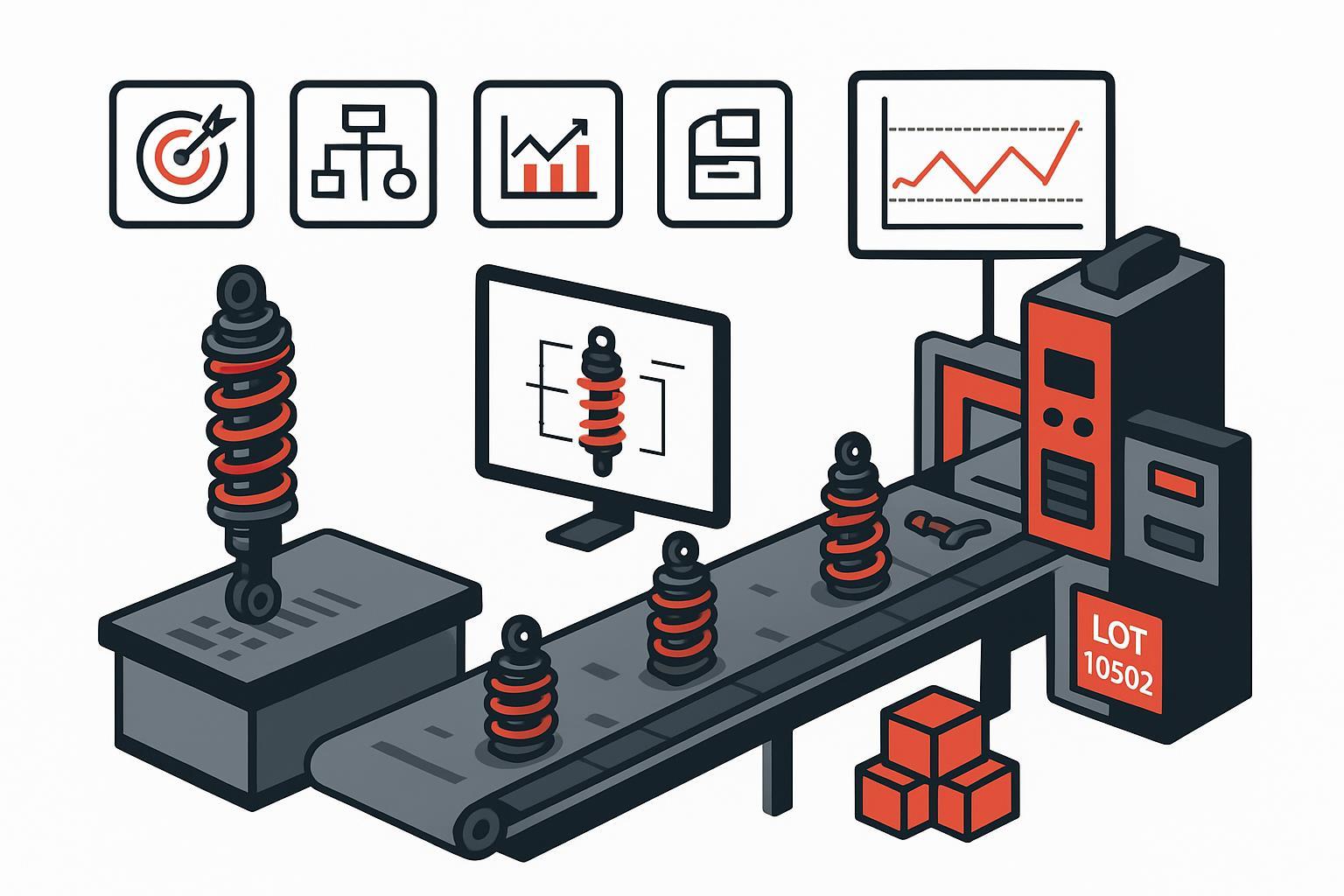
A practical APQP/PPAP-style supplier review boils down to four evidence blocks:
CTQs tied directly to performance and durability
a control plan that keeps those CTQs stable at line speed
MSA (including GR&R) for the measurements you’ll use to accept/reject parts
traceability that can connect field complaints back to lot/shift/process parameters
This isn’t paperwork. It’s how you catch drift before it becomes a warranty event.
Why emerging markets increase OEM suspension risk
Scaling speed exceeds process maturity
Demand can scale faster than the factory system matures.
Volume exposes problems that were irrelevant at low build rates: drift across shifts, tool wear effects, fixture degradation, and parameter stability.
A useful way to frame this is validation maintenance: MedTech Intelligence notes that scale-up often increases variability (tool wear, thermal drift, fixture degradation) and that SPC should be tied to validation maintenance, with signals like parameter drift across shifts and lot-to-lot material response.
Growth outpaces control systems.
Mixed supply ecosystems increase variability
Emerging-market ecosystems often mix imported and local components.
That can mean:
different supplier standards coexisting
uneven documentation quality
inconsistent traceability depth
Ecosystem complexity increases instability.
Weak feedback loops between field and factory
If field failures are not systematically analyzed, the factory keeps repeating them.
Multi-tier networks make this worse. Visibility problems and mismatched management systems are common obstacles in multi-tier supply chains; QIMAone summarizes several multi-tier supply chain visibility challenges that reduce the ability to detect upstream issues early.
No feedback = repeated failure.
How OEMs can reduce failure risk before scaling
If you want a suspension OEM supplier evaluation checklist that engineering, SQE, and procurement can actually use, start by separating “sample proof” from “process proof,” then demand repeatability evidence.
Separate prototype validation from production validation
Treat samples as design proof, not production proof.
A practical gating approach:
prototype validation: performance targets and functional durability
production validation: CTQs, measurement capability, process capability, and reaction plans
Two-stage thinking is required.
Evaluate suppliers based on repeatability, not samples
If you want to avoid “good samples, bad SOP,” ask for evidence that the supplier can repeat outcomes:
batch-to-batch dyno sampling rules and acceptance windows
a traceability model (batch, shift, key process parameters) that matches your warranty risk
Evidence > demonstration.
Build escalation and correction logic early
A stable program assumes drift will happen at some point. The question is whether the control system catches it early.
Define upfront:
what triggers containment (stop-ship conditions)
who owns corrective action
response-time expectations
what evidence is required to release production again
Control system > inspection system.
Decision framework: when motorcycle suspension OEM program failure after SOP risk is low enough to scale
Green zone (low risk)
stable batch output
repeatable dyno results across defined sampling rules
predictable field behavior
supplier can explain and control variation
Yellow zone (controlled risk)
sample success but limited batch evidence
partial visibility into CTQs and control plan
early signs of variation (shift-to-shift drift, lot sensitivity)
Red zone (high risk)
prototype-only validation
no batch stability proof
no clear explanation of process controls or drift mechanism
Where Kingham Tech fits in this evaluation
If your core risk is SOP instability, you’re not just selecting a shock absorber—you’re selecting a manufacturing system.
If you’re an OEM buyer, SQE, or distributor building a program in an emerging-market supply ecosystem, the fastest way to reduce post-SOP surprises is to qualify the supplier’s system before you qualify the product. In practice, that means three checks: CTQs tied to ride feel and durability, proven measurement capability, and traceability that’s strong enough to contain issues fast.
Kingham Tech works with partners who take that stability-first approach, with an OEM/ODM workflow designed to repeat results at scale.
If you want a quick sanity check, share your current supplier’s evidence pack (control plan summary, MSA/GR&R, dyno sampling rules, and traceability approach). We’ll highlight common gaps that cause drift after SOP and suggest what to tighten before you scale.
Learn more about our OEM/ODM workflow: Kingham Tech OEM/ODM partner