

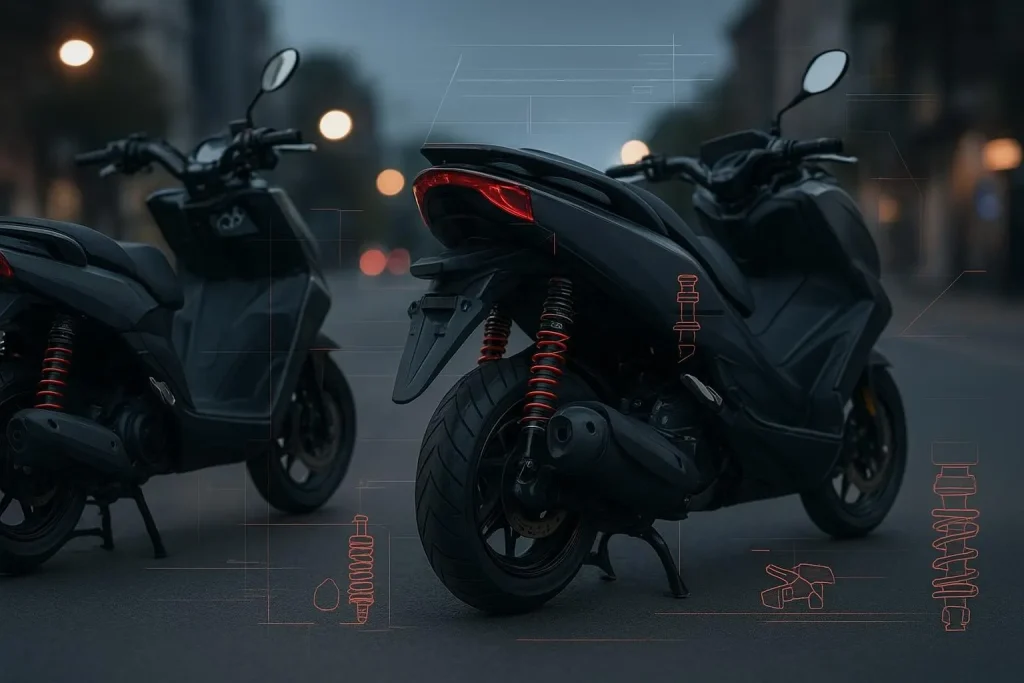
Launching a viable suspension line lives or dies by two early choices: which platforms you cover first and what shock family you lead with. For Yamaha scooters, the most defensible starting point is the North American pair of Zuma/BW’S 125 and XMAX 300. Lead with a performance-oriented family and build it on a modular, common-main-tube architecture. This guide details why that order makes sense, how to spec the shocks, and what to test before release—so distributors and engineering teams can move from concept to pilot inventory with confidence.
Why North America First for Yamaha Scooter Suspension Program Platforms
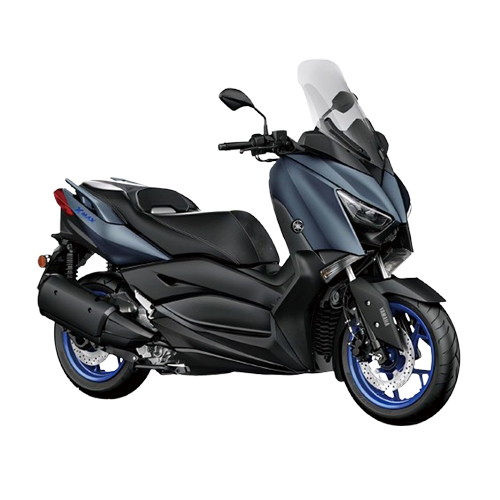
North America gives you two distinct use cases under the Yamaha umbrella without fragmenting SKUs: a rugged 125-class commuter (Zuma/BW’S) and a highway-capable maxi-scooter (XMAX ~292 cc). Both use dual rear shocks with roughly 3.1 inches of travel in stock form, which creates a common baseline for tuning and testing. According to Yamaha Motorsports USA’s model pages, the Zuma 125 features dual shocks and 3.1 inches of rear travel, as documented in the official specifications and features articles for recent model years (Yamaha Zuma 125 — Specs, Yamaha Zuma 125 — Features). For the US‑market XMAX (marketed simply as “XMAX,” 292 cc), Yamaha’s 2023 specifications page also lists dual rear shocks and approximately 3.1 inches of travel (Yamaha XMAX — 2023 Specs).
Use these baselines as constraints, not marketing copy: modest stock travel puts a premium on damping control, spring selection, and thermal management for sustained speed or added loads. That makes North America a practical proving ground: XMAX riders expect highway stability and pitch control, while Zuma 125 owners need durability and predictable chassis response in stop‑and‑go traffic. Beyond the engineering fit, the two platforms simplify commercial setup. You can validate your service tooling, installation guides, and warranty language across two architectures that share dual‑shock layouts, then scale to additional Yamaha scooter families after you’ve proven demand and support processes.
Define the Performance Shock Family for This Launch
Your first-wave family should focus on performance tuning rather than pure value. At minimum, include adjustable preload and rebound; for the XMAX class, offer a reservoir-equipped variant to extend thermal capacity and reduce fade on longer rides.
Why reservoirs matter: separating gas and oil and increasing oil volume improves damping consistency by reducing cavitation and heat-related viscosity change. Reservoir designs also enable more precise compression and rebound control. These are well-established principles: Öhlins’ technology materials on its TTX and STX architectures explain how gas separation and flow paths deliver stable damping across temperatures, and a technical explainer from RevZilla summarizes why riders feel tangible benefits when moving from sealed OEM units to serviceable, tunable shocks (Öhlins — TTX Technology, Öhlins — STX Technology, RevZilla — Are aftermarket motorcycle shocks worth the money?).
Practical tuning targets for a scooter performance family: aim for a usable rebound range (12–16 clicks is typical in the market) to cover solo commuting through two‑up weekend use; publish spring-rate options by duty band rather than exact numbers at launch (solo commuter, two‑up/occasional cargo, heavy urban duty) and revise with measured data; and include an optional reservoir version for XMAX to handle higher sustained speeds and longer heat cycles. Keep the language on features precise and testable. You don’t need to promise lap times; you do need to show that your adjustment range and thermal capacity address the constraints implied by Yamaha’s travel numbers and the platforms’ duty cycles.
Modular Architecture Blueprint
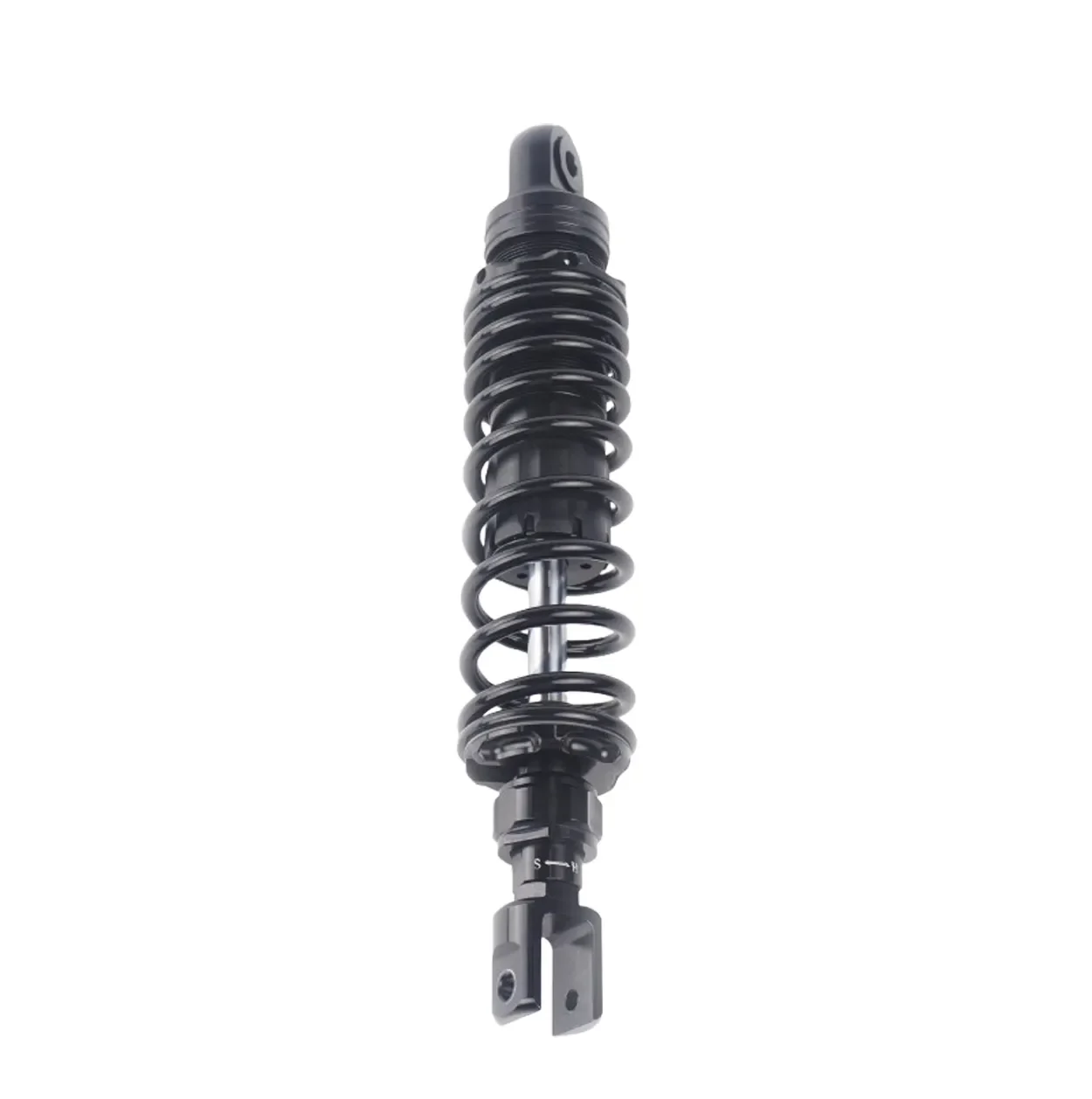
A modular shock architecture lets you maximize cross-platform coverage with fewer unique parts while keeping platform-specific ride quality. The core idea: one common main tube and valving cartridge, then swap bushings, eyelets, springs, and length inserts as needed.
What to standardize and what to vary: standardize the main tube, piston/valving cartridge family, adjuster hardware, and assembly fixtures. Vary spring rate, eyelet/bushing hardware, and optional length inserts or spacers; add a reservoir canister option for the 300‑class. For inventory planning across Yamaha scooter suspension program platforms, target a first‑wave band of roughly six to nine SKUs. One workable mix is: Zuma 125 performance (two spring options), XMAX performance non‑reservoir (two spring options), XMAX performance reservoir (two spring options), plus one heavy‑duty spring kit for fleets if inquiries justify it. Treat this as provisional until fitment and demand data confirm the spread.
Table — Use case to feature mapping
| Use case | Core features | Notes |
|---|---|---|
| Solo commuter 125 | Preload + rebound adjust | Prioritize comfort with mid‑low rebound settings |
| Two‑up 125 | Stiffer spring + +2–3 clicks rebound | Check sag at both fuel loads |
| XMAX sport street | Rebound adjust + reservoir option | Tune for pitch control at highway speeds |
| XMAX touring | Reservoir + heat capacity focus | Validate fade resistance on long gradients |
| Urban delivery | Heavy‑duty spring + firmer valving | Consider service intervals and bushing wear |
This blueprint keeps the engineering work tractable while making it easy for distributors to stock a compact, logical line.
Fitment and Validation Workflow
Before you publish SKUs, collect fitment geometry and run a short validation program. Treat the following as required steps.
Measurement checklist. Capture eye‑to‑eye length (extended and compressed) per platform; bushing inner diameter, outer diameter, and installed width per mount; clearance around fenders and exhaust under full compression; and static/rider sag targets by duty band, confirming the adjuster range covers them.
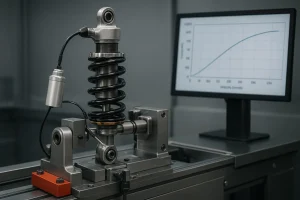
Damping and durability checks. Produce bench‑dyno force–velocity overlays for OE versus your performance unit at low and mid shaft speeds, noting click positions used in tests. Add structural fatigue cycling on the shock assembly with acceptance criteria aligned to scooter duty and document pass/fail thresholds. For environmental robustness, use a recognized neutral salt spray method such as ISO 9227, and clearly declare the method and exposure hours while noting that salt spray is a quality‑control check rather than a life predictor (ISO — Overview of ISO 9227).
For additional context on reservoir/damping architecture and benefits, Öhlins’ technology pages on TTX and STX describe gas separation and flow stability in shock design, which supports the rationale for your reservoir option (Öhlins — TTX Technology, Öhlins — STX Technology).
Document the method alongside highlights of your results; you can redact proprietary numbers while proving that you’ve actually done the work.
Practical Micro‑Example Adapting a Modular Performance Shock From Zuma 125 to XMAX 300
Disclosure: Kingham Tech is our product.
Here’s how a modular approach lets you extend one performance shock across Yamaha scooter suspension program platforms without reinventing the core hardware. Start with the common main tube and valving cartridge tuned for scooter shaft speeds and modest travel. Your Zuma 125 setup uses a spring and rebound range that keeps urban ride quality compliant while stabilizing chassis pitch on hard stops. The eyelets and bushings match the Zuma mounts, and overall length is set to preserve stock geometry. When an XMAX distributor asks for a pilot set, you don’t need a new shock body—you swap to XMAX‑specific eyelet and bushing hardware, step up to a spring suited to the heavier scooter and two‑up use, and add the reservoir canister option to increase oil volume and reduce fade.
On the dyno, you validate that the XMAX variant’s rebound curve has enough headroom to control chassis pitch at higher cruise speeds. On‑bike, you set baseline sag with two riders, then add two clicks of rebound to settle post‑brake oscillation. Because the architecture is shared, spare parts and service procedures stay consistent—distributors can train techs once and apply the process to both platforms. For a deeper engineering overview of performance shock design and testing flow, see Kingham Tech’s page on performance suspension for motorcycles: Performance Suspension for Motorcycle.
Launch and Distributor Playbook
Translate the engineering plan into a lightweight commercial launch that partners can execute quickly. A compact pilot SKU set covers Zuma 125 performance (two spring options), XMAX performance without reservoir (two spring options), and XMAX performance with reservoir (two spring options). If fleet interest emerges, add a heavy‑duty spring kit as an accessory rather than a separate shock SKU at first.
Enablement matters as much as hardware. Provide a fitment and measurement guide with photos and torque specs, plus an installer quick sheet with sag targets, click‑by‑click starting points, and notes for two‑up or cargo use. Clarify warranty terms for rebuilds and service intervals aligned to scooter duty cycles. Seed each distributor with one Zuma and one XMAX set for in‑house installation and a brief test loop, collect feedback on adjuster range, comfort, and pitch control, and offer a short virtual tech session to review installation and tuning. Capture early issues in a shared log and roll fixes into the next production batch.
By starting with Yamaha scooter suspension program platforms in North America and a performance‑first family on a modular core, you keep risk low, learning high, and inventory lean.
Key sources cited in this guide (primary/canonical):
- Yamaha Motorsports USA — Zuma 125: rear dual shocks and 3.1 in travel (Zuma 125 — Specs, Zuma 125 — Features).
- Yamaha Motorsports USA — XMAX (292 cc) 2023: dual shocks and about 3.1 in travel (XMAX — 2023 Specs).
- Öhlins — Technology overviews supporting gas separation and stable damping: TTX Technology and STX Technology.
- RevZilla — Technical explainer on the value of aftermarket, serviceable shocks: Are aftermarket motorcycle shocks worth the money?.
- ISO — Neutral salt spray method context: Overview of ISO 9227.
If you’d like a spec sheet or to discuss a pilot program, contact the OEM/ODM team: Kingham Tech OEM/ODM Partner.