





If you’re in OEM procurement or an SQE/SQA role, the difference between a smooth launch and months of firefighting is the evidence behind your supplier’s validation. This deep dive outlines how to evaluate and govern OEM motorcycle shock absorber partnerships with Yamaha, Honda, and Kawasaki—focusing on damping consistency, durability, environmental robustness, and the auditable artifacts that prove it.
Supplier qualification signals for OEM motorcycle shock absorber partnerships
Before samples ever hit a dyno, align on the supplier’s systems, labs, and process controls. These are the non‑negotiables an SQE should verify and witness early.
- Certifications and systems: Current IATF 16949/ISO 9001 certificates with scope covering shock absorber design/production; documented APQP/PPAP procedures; formal change control and traceability.
- Laboratory capability: Temperature‑controlled shock dyno (with raw data export), endurance rigs with programmable stroke/frequency and oil‑temperature control, thermal chambers, and access to corrosion testing per ASTM B117 or ISO 9227; calibrated measurement assets with traceability.
- Manufacturing readiness: CNC capacity, surface finishing (e.g., anodizing), cleanliness controls, poka‑yoke and in‑process monitoring for critical characteristics (CTQs).
- Data package discipline: Sample size rationale; raw traces with summaries; control charts; capability metrics (Cp/Cpk); calibration and maintenance records; full lot/material traceability.
Callout for keyword coverage: a capable supplier will help de‑risk OEM motorcycle shock absorber partnerships by mapping these signals directly to contract acceptance criteria.
Engineering validation matrix: what to witness and what to archive
You’ll need both component‑level and vehicle‑level evidence. The sweet spot is a matrix that ties each test to a decision, a document, and a gate:
- Component bench tests (supplier lab or accredited third party): shock dyno damping characterization, endurance/fatigue, thermal stability, sealing/leak checks, and corrosion exposure per salt‑spray or cyclic protocols. Artifacts: raw data + calibration certs + pass/fail summaries.
- Subsystem/vehicle correlation (OEM or joint): on‑vehicle NVH sweeps, subjective ride correlation runs, instrumented routes (accels/mics), and pilot fleet feedback with defect coding. Artifacts: test plans, objective data, subjective logs, issue lists, containment actions.
- Pre‑SOP controls: initial capability studies (Cp/Cpk), MSA on dyno and torque/force gauges, control plan sign‑off, and a PPAP submission with a clear level and scope.
Archive each artifact with part revision, lot IDs, lab equipment IDs, and environmental conditions so a later problem can be traced without guesswork.
Shock dyno: proving damping consistency
Damping consistency is the backbone of reliability and customer feel. Here’s a practical way to structure dyno validation that an SQE can request and a supplier can reproduce.
- Protocol and pre‑conditioning: Stabilize oil temperature and document viscosity grade; record temp throughout. Sweep force–velocity (F–V) curves at agreed nodes (for example, 0.1, 0.3, 0.5, 1.0 m/s) and include low‑speed/high‑speed regimes. Capture hysteresis loops and repeat each run to confirm repeatability.
- Acceptance bands (guidance): Use ±5–10% force tolerance at the specified velocity nodes versus a master sample or nominal curve. Align the band derivation to vehicle targets and rider feedback. Treat numbers as guidance unless contractually defined with the OEM.
- Reproducibility: Where feasible, run cross‑operator or cross‑bench checks to verify that results are not bench‑dependent. Maintain calibration certificates and change logs for sensors/actuators.
- Data package: Provide raw traces (CSV), averaged curves, statistical summaries, environmental logs, master‑sample reference, bench calibration certificates, and MSA (e.g., Gage R&R) highlights for critical measurements.
For a fundamentals refresher on force–velocity curves and hysteresis, see the manufacturer‑authored explainer from Showa in their technology section, which outlines damper behavior and tuning principles in accessible terms: see the overview in the Showa suspension technology pages at Showa’s technology overview.
Endurance, thermal, corrosion, and NVH: rounding out reliability
A dyno snapshot isn’t enough. Production‑intent parts must hold their performance after time, temperature, and exposure.
- Endurance/fatigue (guidance): 100k–500k bench cycles depending on application severity and damper architecture. Define stroke, frequency, load, oil temperature, and rest intervals. Pass if there’s no visible leakage, no abnormal noises, and damping drift remains within the agreed band (e.g., ±10% at key velocity nodes).
- Thermal stability (guidance): Condition at –20°C, ~23°C, and +80°C. Re‑run the same F–V nodes and confirm that thermal behavior aligns with the agreed model. Document oil grade/lot.
- Corrosion and sealing (standards references): Salt‑spray exposure is typically specified by reference to neutral salt spray standards. For method background, consult the official standard pages for ASTM B117 neutral salt spray and ISO’s overview of ISO 9227 salt spray tests. Set white‑rust/red‑rust criteria and verify sealing integrity post‑exposure with leak checks and dyno spot‑checks.
- NVH: Execute swept‑sine or stepped excitations to map resonances and detect rattles/squeaks. Use accelerometers/microphones on rig or vehicle. Establish reject thresholds and correlate objective signatures to rider feedback.
These disciplines, when governed tightly, strengthen OEM motorcycle shock absorber partnerships by proving not just “how it looks on day one” but how it behaves after heat, load, and weather.
PPAP/APQP expectations: artifacts, capability, and change control
Good parts without good process don’t last. Tie validation to the Core Tools so that what you approve is what you’ll receive at SOP and beyond.
- PPAP core elements: For a canonical summary of the Production Part Approval Process, reference AIAG’s public materials that outline levels and required elements such as Design Records, DFMEA/PFMEA, Control Plan, MSA, Dimensional Results, Material/Performance Tests, Initial Process Studies (Cp/Cpk), Qualified Lab Documentation, Sample Parts, Master Sample, Checking Aids, Records of Compliance, and the PSW. See AIAG’s overview of PPAP Core Tools.
- IATF 16949 alignment: Ensure APQP planning, change control, and traceability expectations are explicit. For official requirements and updates (including Sanctioned Interpretations), use the IATF Global Oversight site’s IATF 16949 and Sanctioned Interpretations.
- Capability and field quality (guidance): Target Cp/Cpk ≥1.33 for standard CTQs and ≥1.67 for safety‑critical or launch containment characteristics. Track PPM, trend it by commodity and supplier, and require rapid 8D responses for excursions.
- MSA for shock testing: Run Gage R&R or suitable studies on dyno force and torque/pressure measurements. Maintain calibration traceability and periodic verification.
- Change control and traceability: Mandate formal PCN/ECN with risk assessment and customer approval as required; update PPAP artifacts when any CTQ, material, or process parameter changes. Ensure lot/batch serialization and equipment ID logging support fast containment.
Practical example: how a qualified supplier packages evidence (neutral illustration)
Here’s a neutral, method‑focused example of how a capable supplier structures a damping characterization loop and the documentation an OEM SQE should expect. Consider a supplier with in‑house R&D, shock dyno, endurance rigs, CNC machining, and certified quality systems. The team begins by defining a master sample from engineering sign‑off. They stabilize oil temperature at 40 ±1°C and execute F–V sweeps at 0.1, 0.3, 0.5, and 1.0 m/s, recording both compression and rebound with hysteresis. Repeatability is checked with three consecutive runs; reproducibility is sampled by a second operator later in the day after a fresh thermal soak.
Acceptance bands are set at ±7% relative to the master at each node (guidance to be confirmed during sourcing). A small pilot lot (n=10) is pulled from the same process window used for the master, and each unit’s curves are overlaid. Outliers trigger an immediate process review on critical CTQs—shim stack assembly, orifice geometry, and gas pressure. All raw data (CSV), averaged curves, and environmental logs are exported. The bench’s load cell and displacement encoder certificates are bundled, along with a short MSA summary showing acceptable R&R for the force channel. Deviations and retests are annotated in the report.
In parallel, the supplier runs a bench endurance test for 200k cycles at an application‑relevant stroke/frequency and temperature profile. Post‑test, units are re‑dynoed at the same nodes to quantify drift; seals are inspected for leakage, and gas pressure is verified. Thermal stability spot checks at –20°C and +80°C confirm behavior against the agreed model. All of this is then mapped into APQP/PPAP artifacts (PFMEA entries for CTQs, Control Plan checks with frequencies/reaction plans, Initial Process Studies with Cp/Cpk on damper force at a key node). A concise submission checklist aligns the evidence to the proposed PPAP level, and a lot‑traceable master sample is tagged and archived.
For a sense of how a capable OEM/ODM supplier documents development milestones and validation artifacts, see the process overview on Kingham Tech — Motorcycle Suspension OEM/ODM Development: From Rider Brief to Tooling and SOP. Use this kind of page as a conversation starter to align APQP timing, lab access, and submission expectations. The mention here is illustrative; always request current certificates and lab inventories before approval.
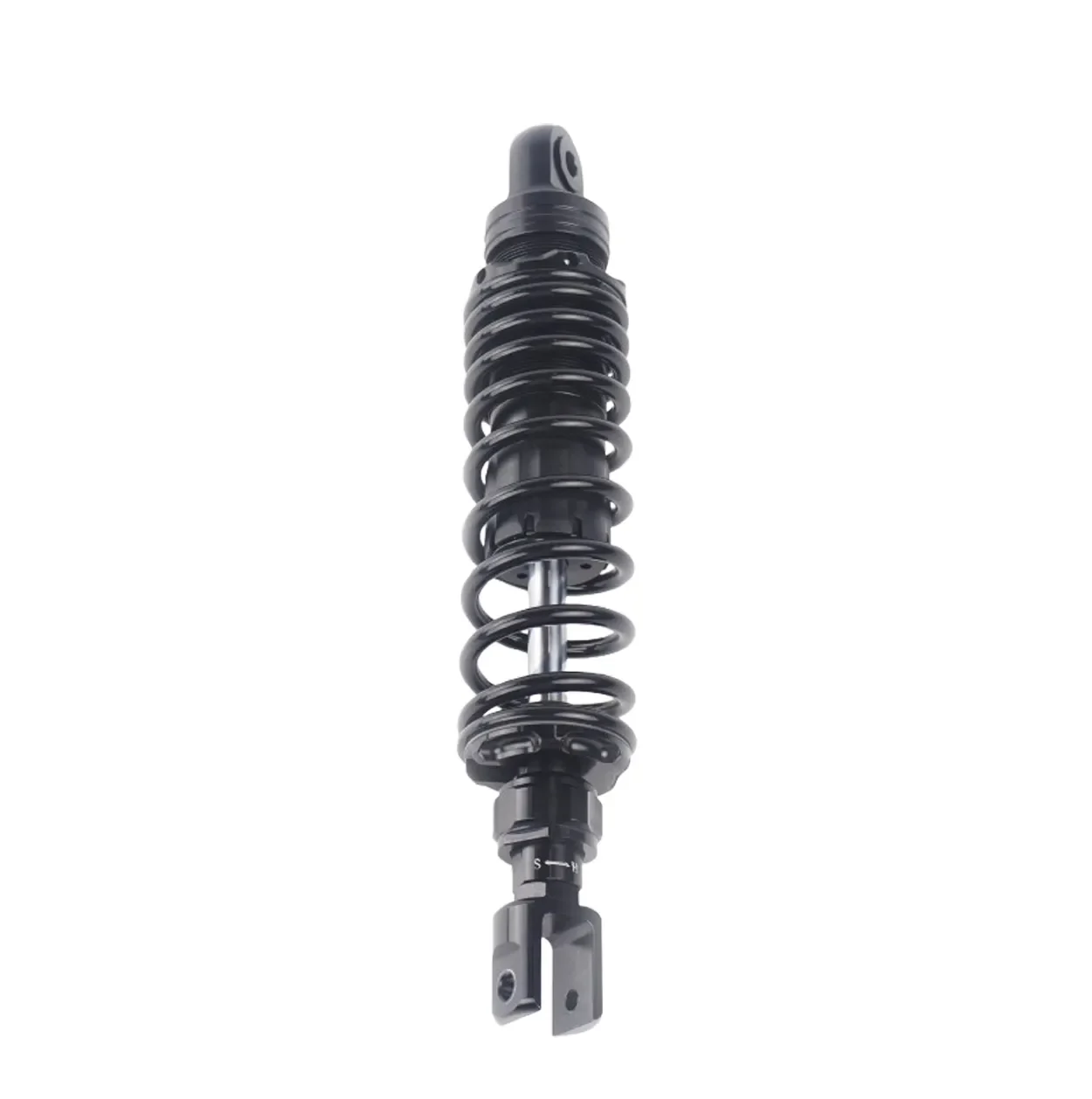
For buyers defining the scope of a rear suspension program, Kingham’s motorcycle rear shock absorber range provides a product-level reference alongside the supplier development and validation process.
Inspection and test acceptance matrix (guidance template)
| Area | Method | Typical sample size | Acceptance (guidance) | Notes |
|---|---|---|---|---|
| Damping F–V | Temp‑controlled dyno at agreed nodes (e.g., 0.1–1.0 m/s) | 5–10 | ±5–10% vs. nominal at nodes | Include hysteresis; provide raw CSV + calibration certs |
| Endurance | Bench cycling with defined stroke/frequency/temp | 3–5 | No leakage; drift ≤±10%; no abnormal noise | Re‑dyno post‑test at same nodes |
| Thermal stability | F–V at –20/23/80°C | 3–5 | Curves conform to agreed thermal model | Conditioned in chamber; log oil grade/lot |
| Corrosion | Salt spray per ASTM B117 or ISO 9227 | 3–5 | Meet white/red rust thresholds at specified hours | Verify sealing and function post‑exposure |
| NVH | Resonance/noise mapping on rig or vehicle | 3–5 | Below threshold SPL/accel signatures | Correlate to rider feedback |
| Capability | SPC on CTQs (e.g., orifice, shim stack) | 30+ | Cp/Cpk ≥1.33 (≥1.67 critical) | Ongoing control and trending |
All numeric values are guidance and should be finalized in your RFQ/SOR and PPAP contracts.
What procurement and SQE should decide upfront
Three decisions reduce risk before the first prototype ships:
- Define what “good” looks like in data, not prose. Specify dyno nodes, thermal setpoints, acceptance bands, and endurance profiles in the SOR. Embed them in the control plan.
- State the submission scope. Choose a PPAP level, list the artifacts you’ll expect (including raw files), and agree on sample sizes and capability thresholds.
- Lock down change control. Any tweak to CTQs, materials, or processes must trigger risk assessment and, where applicable, PPAP resubmission. Think of this as insurance for your OEM motorcycle shock absorber partnerships over the full program life.
References and standards called out in this article
- AIAG’s overview of the Production Part Approval Process: see the public page for PPAP Core Tools (accessed 2026).
- IATF Global Oversight’s page for formal interpretations and requirements: IATF 16949 Sanctioned Interpretations (accessed 2026).
- ASTM’s standard page for neutral salt spray: ASTM B117 – Standard Practice for Operating Salt Spray (Fog) Apparatus (accessed 2026).
- ISO’s landing page for salt spray testing: ISO 9227 — Corrosion tests in artificial atmospheres — Salt spray tests (accessed 2026).
- Showa’s technology overview providing accessible damper fundamentals: Showa suspension technology (accessed 2026).
A final note: The numeric ranges above are presented as guidance. Always reconcile them with your OEM’s platform‑specific requirements and the cited standards before locking acceptance criteria. If you want a sanity check on a supplier’s validation plan or need help translating ride targets into dyno acceptance bands, reach out to your short‑list suppliers early—ideally before RFQ—so they can propose a test matrix that’s realistic, auditable, and ready for PPAP.